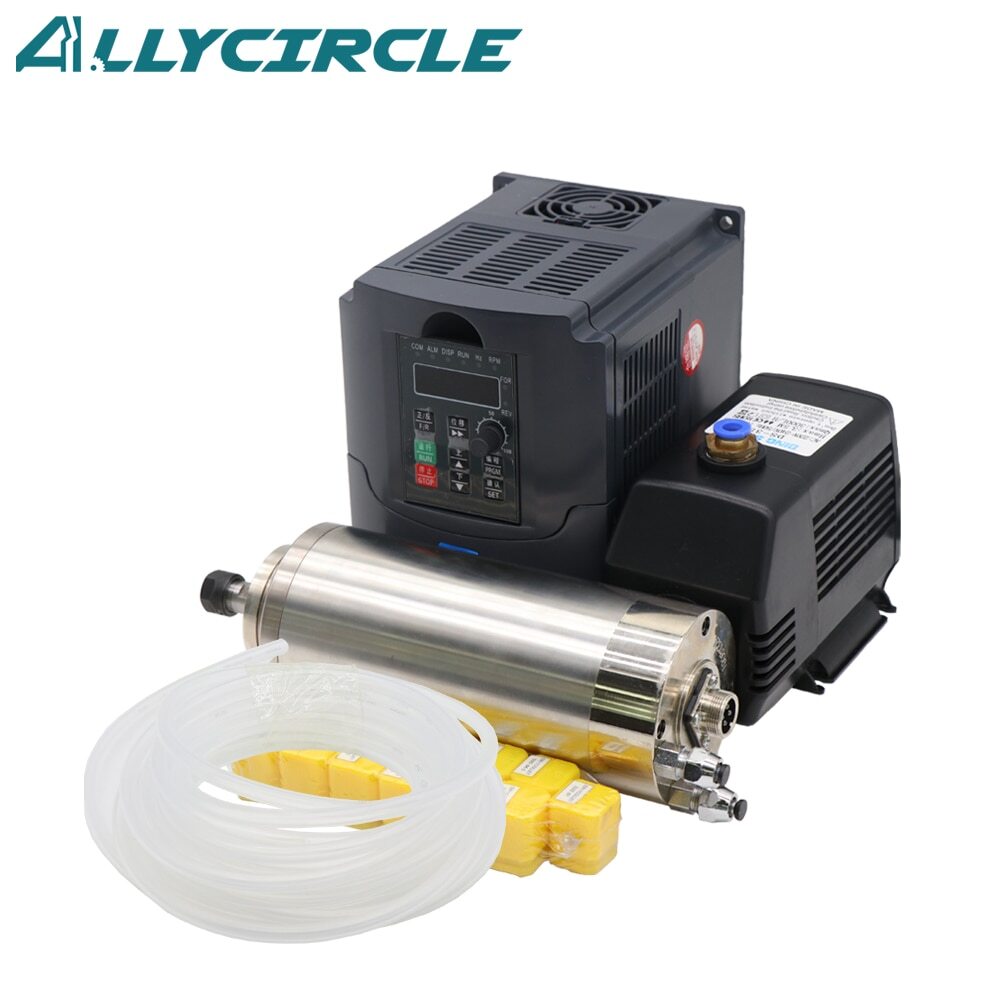
800W vs 1.5kW vs 2.2kW CNC Spindle: Pick the Right Wattage
Spindle power and operating speed together determine available cutting torque; the wattage label alone is not a torque curve.
Table of Contents
- What Wattage Actually Controls
- 500–800W Spindles: Lightweight Option
- 1.5kW Spindles: The Hobbyist Standard
- 2.2kW Spindles: Production and Aluminum
- Machine Size and Spindle Wattage Table
- Power Delivery and Electrical Reality
- Collet Size and Bit Availability
- Speed/Torque Trade-off Chart
- Weight and Z-Axis Motor Sizing
- When to Buy What
- What We'd Buy
- Shop This Guide
- Related Articles
What Wattage Actually Controls
Mechanical power is torque multiplied by angular speed. Compare torque at your actual cutting RPM: a high-speed spindle may deliver much less than its rated power at low speed, and its permitted speed range also depends on the motor and cooling.
Depth of cut depends on cutter geometry, engagement, material, feed, spindle speed and machine rigidity. A wattage label alone cannot establish a cut that one spindle will complete and another will not.
500–800W Spindles: Lightweight Option
Typical specs:
- Wattage: 500–800W
- Weight: check the selected motor's net mass
- Common collet: ER11 or ER16
- Typical max rpm: 24,000
- Cost: ~$100–120
Use cases:
- Light engraving on a machine designed for a cutting spindle
- Machines whose stiffness, mounting and cutting requirements suit a smaller spindle
- Wood, plastics and light metal work, depending on the machine and spindle
A small spindle limits material-removal rate, but does not automatically rule out hardwood or aluminum. Match tool size and engagement to available torque, rigidity and chip evacuation.
Z-axis impact: check spindle mass, mount stiffness, screw lead and motor torque at the required speed
1.5kW Spindles: The Hobbyist Standard
Typical specs:
- Wattage: 1.5kW
- Weight: model-dependent; use net motor mass
- Collet: model-dependent, including ER11 on common 1.5 kW kits
- Typical max rpm: 24,000
- Cost: ~$150–180
Use cases:
- MPCNC only if the mount and moving mass suit the chosen build; a trim router can be more appropriate
- Hobby routers whose mount, Z axis and intended tools suit the selected spindle
- Production wood work (multiple parts, consistent feeds)
A suitable 1.5 kW spindle can cover a range of wood and aluminum work. Use tool-specific chip loads and engagement, and respect torque and cooling limits. It can still stall or chatter if the cut exceeds what the complete machine can support.
Z-axis impact: calculate lifting and acceleration loads using the actual spindle mass, screw lead, friction and available motor torque. NEMA frame size alone does not determine suitability or rapid speed.
Electrical supply: some matched kits accept a low-voltage single-phase input, but use the VFD's rated input current and installation manual to size the circuit. Motor current and spindle watts are not the same as mains input current.
2.2kW Spindles: Production and Aluminum
Typical specs:
- Wattage: 2.2kW
- Weight: check the selected motor's net mass
- Common collet: ER20 (sometimes ER25 on special models)
- Typical max rpm: 24,000
- Cost: ~$200–250
Use cases:
- Aluminum work requiring the selected spindle's torque and tool capacity
- Machines whose tooling and material-removal requirements justify this power class
- Long jobs within the spindle's rated duty and cooling limits, with appropriate supervision
- Surfacing tools whose shank, maximum RPM and load are within the spindle and machine limits
An ER20 spindle can accept a matching 1/2-inch collet, which opens up larger-shank tooling. More available power can support heavier cuts, but chatter, stalling and surface finish still depend on the complete machine, cutter and toolpath.
Z-axis load depends on actual motor and mount mass. Size the axis using its force, screw lead and torque-speed requirements; a bigger NEMA frame is not automatically necessary or faster.
Electrical supply: choose a VFD explicitly rated for your input voltage and phase, with an output matched to the motor. Size circuit protection and wiring from that drive's installation requirements, not spindle watts divided by wall voltage.
Machine Size and Spindle Wattage Table
| Machine Size | Work Area | Primary Material | Recommended Wattage |
|---|---|---|---|
| 3018 (stock) | 300×180mm | Plastic, soft wood | Use a spindle approved for the specific 3018 Z assembly and controller |
| MPCNC 500mm | 500×500mm | Wood, soft plastic | A compatible lightweight tool, often a trim router; verify the V1 mount |
| DIY router 600mm | 600×600mm | Hardwood, aluminum | Choose from required torque, tooling and Z-axis capacity |
| Production router 800mm | 800×800mm | Mixed (wood + aluminum) | Choose from the production process, duty rating and tool sizes |
| Large format 1000mm+ | 1000×1000mm+ | Material capability depends on the complete machine | Select spindle and drive from required torque, speed and duty |
Power Delivery and Electrical Reality
Low-voltage single-phase supply: check the actual voltage and the VFD's input rating
- Available continuous load depends on the installed circuit, protection, other loads and local requirements
- 800 W class: use the VFD nameplate input current
- 1.5 kW class: use the VFD nameplate input current
- 2.2 kW class: confirm the drive is approved for the available input supply and circuit
220V household power (common in garages):
- Available circuit capacity must be checked; voltage alone does not set it
- 1.5 kW class: use the selected drive's rated input current and protection table
- 2.2 kW class: use the selected drive's rated input current and protection table
Before buying, check whether the workshop supply meets the chosen VFD's installation requirements. If it does not, have the circuit assessed and changed as needed rather than substituting a larger breaker.
Collet Size and Bit Availability
The spindle's chuck design determines collet size; wattage does not:
- 800W: ER11 (up to 7mm shank) or ER16 (up to 10mm)
- 1.5 kW: check the exact model; ER11 versions are common
- 2.2kW: ER20 (13mm / 1/2" shank)
Choose collets to match the cutter shanks you intend to use. A larger shank can reduce tool bending, but small cutters can also machine aluminum; spindle and tool limits still apply.
Aluminum does not require ER20. Choose cutter diameter and shank for the feature, engagement and machine; buy a spindle whose collets fit those tools.
Speed/Torque Trade-off Chart
Weight and Z-Axis Motor Sizing
Spindle mass is one input to Z-axis sizing, alongside screw lead, efficiency, friction, gravity and acceleration:
| Spindle Wattage | Typical Weight | Z-Axis Motor | Z Rapid Speed |
|---|---|---|---|
| 800W | Use the selected spindle's net mass | Size from torque at speed and axis mechanics | Calculate and verify on the completed axis |
| 1.5kW | Use the selected spindle's net mass | Size from torque at speed and axis mechanics | Calculate and verify on the completed axis |
| 2.2kW | Use the selected spindle's net mass | Size from torque at speed and axis mechanics | Calculate and verify on the completed axis |
Before a spindle swap, compare actual moving mass and the axis torque-speed margin. The existing Z axis may be adequate or may need changes; verify it under the intended load before increasing acceleration.
When to Buy What
800 W: consider it when tool size, material-removal needs and mounting limits suit a smaller spindle. It is not restricted to foam and engraving, and the complete system cost matters more than wattage alone.
1.5 kW: a useful option for a suitably rigid hobby router when its mass, collet, speed range and electrical requirements fit. Select the specific model instead of treating this wattage as a universal default.
2.2 kW: consider it when the intended tooling and cut actually need more torque or a larger collet. Check mass, Z-axis capacity, cooling and the chosen VFD input requirements; larger bed size alone is not the deciding factor.
What We'd Buy
First build: choose a spindle or trim router that fits the machine's mount, mass limit and tooling. Many 1.5 kW kits use ER11, and V1 lists lightweight tool options for MPCNC; do not assume ER20 or universal 1.5 kW compatibility.
Aluminum-focused build: a properly matched 2.2 kW ER20 system may be useful, but price the motor, VFD, mount, cooling and electrical installation together and check actual cutting requirements.
Second spindle: buy only for a defined need, such as different speed range or tool capacity, and check mounting, alignment, cooling and VFD compatibility before swapping.
Shop This Guide
| Item | Where | Link |
|---|---|---|
| 800W Spindle Kit | Vevor | 800W spindle kit on Vevor → |
| 1.5kW Spindle Kit | Vevor | 1.5kW spindle kit on Vevor → |
| 2.2kW Spindle Kit | Vevor | 2.2kW spindle kit on Vevor → |
| 1.5kW/2.2kW Spindle Sets | AliExpress | |
| Huanyang VFD 1.5kW | Amazon | Huanyang VFD 1.5kW 110V on Amazon → |
Parts for this guide
If you are buying after reading this, these are the specs to look for.
| Part | What to buy | Where to look |
|---|---|---|
| Matched spindle and VFD for small-shank tools A reader choosing the middle power class needs a complete electrically matched system for the intended small-shank cutters. | 1.5 kW water-cooled ER11 spindle with a documented body diameter and rated frequency, paired with a VFD whose input suits the workshop and whose output voltage and current suit that exact motor. | |
| ER20 half-inch collet A reader choosing ER20 for larger cutters needs the actual half-inch collet rather than assuming the kit includes it. | ER20 collet sized for a 12.7 mm or 1/2-inch shank, used only with an ER20 spindle and a matching nut; respect the tool's maximum RPM. | |
| Spindle clamp sized to the motor A reader changing power class needs to confirm that the new motor can be mounted rigidly on the Z axis. | 65 mm or 80 mm bore only as specified by the selected spindle drawing; require a bolt pattern compatible with the existing or designed Z plate. |
"Search" buttons open a search for that exact spec, so compare listings against it before buying. Some links earn us a commission at no extra cost to you (disclosure).