Air-Cooled vs Water-Cooled CNC Spindles: Noise Wins
Compare air-cooled and water-cooled CNC spindles for noise, maintenance, cooling performance, and which option makes more sense for a hobby CNC router.
Table of Contents
- Air-Cooled: How It Works
- Water-Cooled: How It Works
- Noise Levels: Measure the Complete Setup
- Spindle Orientation Matters
- Cost Difference (Smaller Than You Think)
- Maintenance and Failure Modes
- DIY Water Cooling Setup
- Spindle Speed Range and Collet Options
- Real-World Expectation
- What We'd Buy
- Shop This Guide
- Related Articles
Air-Cooled: How It Works
An air-cooled spindle uses airflow to remove heat from the motor body. Some have a shaft-driven fan; others use an independent electric fan. Keep the specified air path clear and follow the model's installation instructions.
The trade-off: cooling airflow adds fan noise to the motor and cutting noise. How loud it gets depends on the spindle, speed, load and where you measure it.
Airflow can disturb chips, and dust buildup can restrict cooling. Keep the inlet and cooling passages clear and use effective dust extraction.
Maintenance: inspect the fan, air passages and cooling fins, and keep them clear according to the spindle manual.
Water-Cooled: How It Works
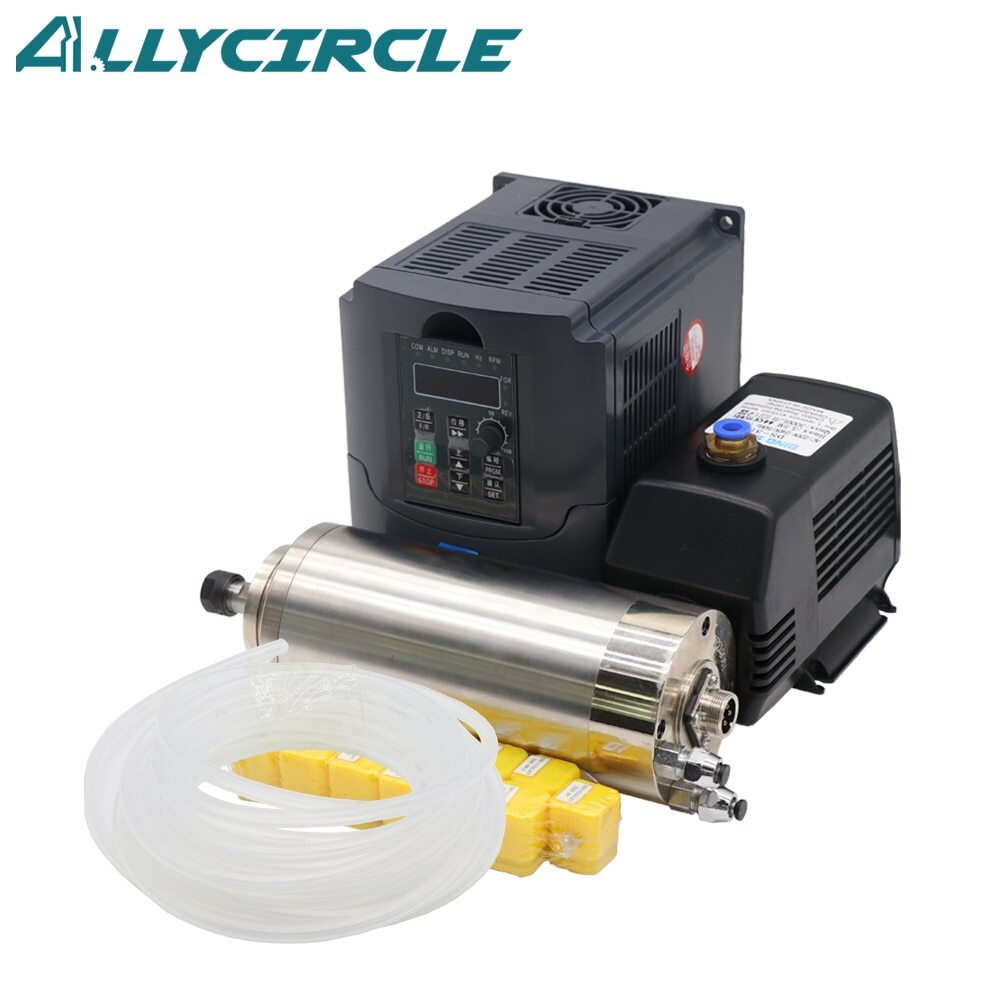
The spindle motor body is sealed. External hoses connect to a pump (could be an aquarium pump and a 5-gallon bucket, or a proper CNC chiller). Water circulates through the motor jacket, absorbs heat, returns to the reservoir.
A water-cooled spindle removes the shaft-fan noise, but its bearings, cutting tool and cooling equipment still make sound. Pump and chiller noise vary with the equipment and mounting.
Real-world advantage: there is no spindle cooling fan blowing air toward the work. Chips still move with the cutter and extraction airflow; water cooling does not replace dust control or suitable spindle sealing.
Maintenance: check coolant flow, level and leaks before use. Use the spindle and cooling-system maker's approved water or coolant mixture and replacement schedule. Do not dose an unidentified RV antifreeze by the capful; RV waterline products are not automatically suitable spindle coolants.
Noise Levels: Measure the Complete Setup
Decibels are logarithmic. A 10 dB difference is perceived as roughly 2× louder:
| Source | dB |
|---|---|
| Whisper | 30 |
| Normal conversation | 60 |
| Trim router (Makita) | Check the exact router's published noise data |
| Air-cooled 1.5kW spindle | Measure the spindle, cutting and extraction together |
| Water-cooled 1.5kW spindle | Measure the spindle, cutting and extraction together |
| Lawn mower | 90 |
| NIOSH recommended occupational exposure limit, 8-hour average | 85 dBA |
Water cooling can reduce spindle fan noise, especially when idling. During cutting, the cutter and dust extractor may dominate. Assess the complete job's noise and exposure before deciding on hearing protection or a shared-space installation.
Spindle Orientation Matters
Air-cooled: use the mounting orientation permitted by the manufacturer and leave the fan inlet and outlet unobstructed. A normal router spindle points vertically along Z; cooling type alone does not impose a horizontal mounting rule.
Water-cooled: forced coolant circulation can support different layouts, but use the manufacturer's permitted orientation and purge trapped air. Cooling type alone does not establish unrestricted mounting.
Cost Difference (Smaller Than You Think)
Air-cooled 1.5kW spindle kit (Vevor/AliExpress):
- Spindle + matching VFD: budget roughly $150 to $180, then check wiring, enclosure and mounting costs
- Install time: depends on mounting, wiring and commissioning
- Total: ~$180
Water-cooled 1.5kW spindle kit:
- Spindle + matching VFD: budget roughly $180 to $220 before cooling, wiring and mounting
- DIY cooling setup (aquarium pump + bucket + hoses): ~$25
- Manufacturer-approved coolant or water treatment: budget separately
- Install time: depends on mounting, wiring and commissioning
- Total: ~$210–250
The delta is $30–70. For a hobby shop, that's lunch money.
Maintenance and Failure Modes
Air-cooled failure modes include obstructed airflow, fan trouble, bearing wear and winding faults. Inspect cooling and follow the motor's temperature limits; a VFD fault does not detect every overheating problem.
Water-cooled failure modes include pump failure, leaks and blocked hoses. A basic spindle and VFD may have no coolant sensor. Add and test a suitable flow or temperature alarm and interlock if the system does not provide one.
Both cooling types need inspection. Water cooling adds a circulation loop whose failure must be detected by the installed monitoring system.
DIY Water Cooling Setup
For light hobby use, a pump and reservoir may be enough if flow and coolant temperature stay within the spindle's limits:
- Coolant-compatible pump: select for the required flow through the complete loop at its actual resistance
- 5-gallon bucket (or larger): $5
- Coolant-compatible tubing: match the spindle fittings, required bore and moving bend radius
- Quick-disconnect fittings (optional, makes changing hoses easier): $10
- Coolant: use the mixture and concentration approved for the spindle, pump and cooling unit
Budget roughly $40 to $50 for basic loop hardware, then allow for compatible coolant, monitoring and any extra heat rejection the spindle needs.
Before cutting, start the pump, confirm return flow and clear trapped air. Follow the spindle's warm-up procedure and the coolant maker's inspection and replacement instructions.
A radiator and fan can improve heat rejection. For longer jobs or warmer shops, check whether the cooling unit can hold the required temperature; a simple radiator cannot refrigerate below ambient.
Spindle Speed Range and Collet Options
Use the spindle's specified operating range, not the VFD's zero-speed setting. For example, VEVOR lists 8000 to 24000 RPM for its 1.5kW water-cooled ER11 spindle. Torque and cooling limits still apply within that range.
- High RPM (18,000–24,000): Small end mills, engraving bits, PCB drilling
- Mid RPM (10,000–18,000): Standard wood and plastic cutting
- Low RPM: only within the spindle maker's permitted range; match the tool diameter, material and required torque.
Air and water cooling can both serve high-speed spindles, but their allowable minimum speeds and duty limits are model-specific.
Collet size (ER11, ER16, ER20) is independent of cooling type. Pick the collet size based on spindle wattage and bit requirements, not cooling.
Real-World Expectation
Air-cooled: fan noise can be noticeable, but room-to-room transmission depends on the building and setup. Base hearing protection on the complete machine's noise and exposure.
Water-cooled: quieter idling does not guarantee quiet cutting. Measure the machine with the cutter and extraction running, and use hearing protection appropriate to the exposure.
For a shared space, water cooling is worth considering alongside an enclosure, dust-extractor noise and vibration isolation.
What We'd Buy
For a budget-focused solo shop: consider a compatible 1.5kW air-cooled kit from VEVOR, Huanyang or another documented supplier. Check the exact motor, VFD, speed range and mounting, and assess noise with the cutter and extraction running.
For a shared space: consider a 1.5kW water-cooled kit and a properly sized cooling loop. Budget around $250 as a starting point, then verify what is included and measure cutting noise before promising quiet operation.
Never pick solely by cooling type. Match spindle weight, power, speed range, mains and VFD voltage, and collet capacity to the machine and cutters. Verify the actual collet series; many 1.5kW models use ER11.
Shop This Guide
| Item | Where | Link |
|---|---|---|
| 1.5kW Water-Cooled Spindle Kit | Vevor | 1.5kW water cooled spindle kit on Vevor → |
| 1.5kW Air-Cooled Spindle Kit | Vevor | 1.5kW air cooled spindle kit on Vevor → |
| Huanyang 1.5kW Water-Cooled Bundle | AliExpress | |
| Aquarium Pump 120GPH | Amazon | aquarium pump 120GPH CNC cooling on Amazon → |
| Vinyl Tubing 1/2" ID | Amazon | Vinyl Tubing 1/2 inch on Amazon → |
| 65mm Spindle Mount Bracket | Amazon | 65mm spindle mount bracket CNC on Amazon → |
Parts for this guide
If you are buying after reading this, these are the specs to look for.
| Part | What to buy | Where to look |
|---|---|---|
| Matched spindle and VFD kit The reader needs a motor, drive and mounting combination that fits the planned spindle conversion. | For a suitable 65mm mount: 1.5kW, 220V, ER11 spindle rated 8000 to 24000 RPM and 400Hz, with a VFD rated for its current and the available mains input; choose air or water cooling deliberately. | |
| Pump and covered reservoir The reader choosing water cooling needs reliable circulation and a reservoir protected from workshop debris. | Continuous-duty pump compatible with the approved coolant, with a published flow-versus-head curve meeting the spindle's flow requirement through the installed hoses; covered reservoir with level indication. | |
| Cooling flow monitor The reader needs the machine to detect a loss of coolant circulation during cutting. | Coolant-compatible inline flow switch with a documented trip point below normal loop flow, matching hose fittings and an electrically compatible controller or VFD interlock input. | |
| Coolant hose and fittings The reader needs leak-resistant hoses that keep flowing throughout the machine's travel. | Coolant-compatible flexible hose matched to the spindle barb or push-fit dimensions, with a dynamic bend radius suitable for the cable carrier and correctly sized retainers. |
"Search" buttons open a search for that exact spec, so compare listings against it before buying. Some links earn us a commission at no extra cost to you (disclosure).