Maslow 4 and 4.1 CNC Guide: Compact Storage, Full-Sheet Routing
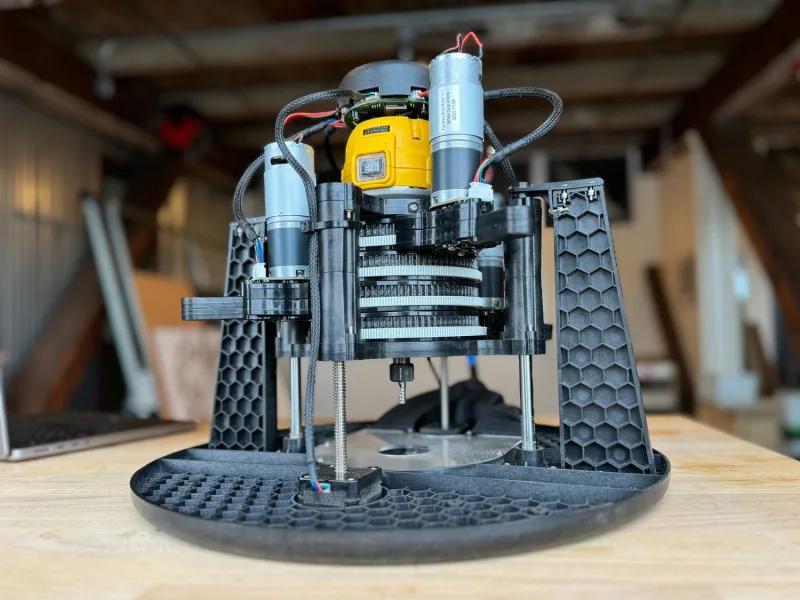
Maslow moves a router sled using four anchored belts. It can work horizontally or on a tilted frame, and stores compactly after use. Budget for the router, work surface and anchors separately from the kit.
Table of Contents
- The Fundamental Design: Four Belts and a Router Sled
- Original Maslow vs. Maslow 4: The Critical Difference
- Accuracy and Calibration
- Build & Frame
- Motor & Spindle Reality
- Controller & Firmware
- What You Can Actually Cut
- Footprint vs. Capability: The Genius Part
- The Vertical Work Reality Check
- Upgrade Path & Expansion
- Community & Documentation
- When Maslow 4 Wins
- When Maslow 4 Loses
- Verdict
- Shop This Guide
- Related Articles
Maslow is worth considering when permanent CNC table space is difficult to spare. The sled stores compactly, but cutting needs a rigid work surface and a larger four-anchor layout. Choose horizontal or tilted operation to suit the shop, and price the router and frame separately.
Original Maslow machines used two chains. Maslow 4 uses four independently controlled belts and a powered Z axis. Sheet profiles are a natural use, and shallow relief is possible while the sled remains supported. Setup and calibration determine whether results meet your project tolerances.
The Fundamental Design: Four Belts and a Router Sled
Maslow uses four anchors around its cutting region instead of a gantry. The sled rides on the work surface; an inclined frame or a horizontal surface can support it.
This is either genius or weird depending on your space. Genius if your shop is a corner of your garage and you have wall space. Weird if you have a dedicated machine area and floor space to spare.
Original Maslow vs. Maslow 4: The Critical Difference
Original Maslow: two-chain drive
- Two motor-driven chains positioned the sled
- Anchor layout and chain geometry affected performance across the sheet
Maslow 4: four-belt drive
- Closed-loop belt control positions the sled
- Test corner accuracy on the chosen frame and calibration
- Firmware handles geometry compensation
- Evaluate repeated parts before relying on it for production
Maslow is an open-source project developed by its team and contributors. For a current purchase, compare the Maslow 4.1 kit and its documented updates with any earlier kit on offer.
Accuracy and Calibration
A properly tuned Maslow 4:
- Accuracy: The maker expects cuts within about plus or minus 0.5 mm after calibration; this is not an independent repeatability test.
- Edge quality: clean, acceptable for furniture parts
- Corner accuracy: Verify with test cuts across the intended work area
- Usable area: Check the anchor geometry and layout simulator
For cabinet parts, shelving and signs, compare measured test pieces with the tolerances the design needs. A successful outline cut does not establish repeatable production accuracy.
Build & Frame
Choose a documented horizontal or inclined frame layout with rigid anchors outside the cutting area. Do not size the anchor rectangle to the sheet alone; allow room for the sled and usable belt geometry.
Use the frame drawing to make a material list and plan assembly. Brace and secure it so cutting loads cannot move the anchors.
Motor & Spindle Reality
Maslow 4 uses:
- Four geared DC servo motors drive the belts; two stepper motors move Z
- DeWalt DWP611, or D26200 for the supported European version
- Use the supplied matched power system; the belt servos are 24 V
- Controller: custom firmware on ESP32 (community-driven, excellent)
Cost breakdown:
- Current shop listing: Maslow 4.1 kit at $525, shown sold out when checked
- Self-sourcing: Price a complete, revision-matched bill of materials first
- Add frame materials: ~$100
Total: Kit plus compatible router, anchors or frame, work surface, shipping and any import charges
Controller & Firmware
Maslow 4 runs custom firmware on an ESP32 board. The controller is open-source and actively maintained by the community. It handles:
- Belt-length measurement and geometry calculations
- Motor speed synchronization (critical; any sync error causes skew)
- Belt retraction, homing and calibration routines
- Upload CAM-generated G-code through the local browser interface
Firmware setup, calibration and troubleshooting are part of getting the machine running. Use the instructions for the installed revision.
What You Can Actually Cut
Good use cases:
- Cabinet doors and sides
- Plywood shelving and brackets
- Wooden signs and panels
- Acrylic sheet with suitable tooling, support and cutting settings
- MDF work
- Panel patterns for larger projects
Bad use cases:
- Deep relief or work that leaves the sled unsupported
- Small loose parts that cannot safely support the sled or remain secured
- Metal work without a validated process for the particular machine and material
- Cutting forces still act on the sled and work; gravity does not remove the need for rigid support and extraction
Maslow suits supported sheet work and some shallow relief. Check calibration, material behavior and sled support against the jobs you actually need.
Footprint vs. Capability: The Genius Part
| Machine | Floor Footprint | Work Area | Best For |
|---|---|---|---|
| Maslow 4 | Depends on frame and anchor layout | Full-sheet capability with suitable anchor layout | Flat panels, signs, cabinet parts |
| LowRider CNC | Supporting table and rail footprint | 48×96" | Same, but floor-sitting |
| MPCNC Primo | Depends on chosen build size | Custom, build-dependent | Smaller precision work |
| PrintNC | 48×48"+ (build-dependent) | Custom, build-dependent | Aluminum, mixed materials |
Maslow can store compactly when its belts are retracted. Frame storage depends on the design. A LowRider gantry can also be removed from its table, so compare actual storage plans rather than assuming a permanent floor footprint.
The Vertical Work Reality Check
Mounting work to a vertical surface requires:
- Hold-downs: you can't rely on gravity; clamps are essential
- Dust management: chips fall straight down (good) or get pressed into work (bad, depending on tool height)
- Bit contact: the tool pushes work away; you need mechanical support
Plan workholding so the sheet stays fixed and the sled can slide without striking clamps. Setup effort depends on the job and frame.
Upgrade Path & Expansion
Maslow 4 is relatively static. You upgrade by:
- Router changes: Use a supported router or a documented conversion
- Belt and calibration checks: Follow the revision-specific procedure
- Firmware updates: the community pushes improvements regularly
Work area can change with anchor layout within the belt and geometry limits. Upgrades and calibration should follow the instructions for the installed hardware revision.
Community & Documentation
- Official site: maslowcnc.com; documentation: documentation.maslowcnc.com; forum: forums.maslowcnc.com
- GitHub: firmware and hardware files
- Use the official forum for traceable setup and troubleshooting discussions
- Use build videos that match the hardware revision
The official forum and open documentation provide places to compare builds and troubleshoot. Check that advice matches your revision.
When Maslow 4 Wins
- You can accommodate a suitable inclined frame or temporary horizontal setup
- You want full-sheet capability and can budget for the kit plus the required extras
- Flat panel work is 80% of your cutting: optimized for this
- You value compact storage and can provide a suitable working layout
- Maker spaces & community shops: excellent for shared spaces where floor footprint is precious
When Maslow 4 Loses
- You need deep relief, unsupported cavities or a conventional rigid gantry workflow
- Your required precision is not demonstrated by calibration and representative test cuts
- You need routine metal cutting with proven process settings and stiffness
- Heavy cuts need validated settings, rigid anchors and suitable belt tension
Verdict
Maslow offers full-sheet routing with a sled that stores compactly. Its four-belt drive, required anchor layout and setup effort differ from a gantry router. The current 4.1 kit needs a separate compatible router and work surface, so compare complete costs before choosing.
Consider it for supported sheet projects when you can build and calibrate the setup. For tight tolerances, deep relief or regular metal work, require representative test cuts before committing.
Shop This Guide
| Component | Source | Notes |
|---|---|---|
| Maslow 4 Kit | Maslow.community shop → | Official kit, includes motors, electronics, cables; frame DIY |
| Makita RT0701C Router | Amazon → | THE standard for Maslow; proven, reliable, good trim router |
| Lumber for Frame | Local hardware store | 2×4, approximately 80–100 board feet depending on design |
| Plywood Work Surface | Local home center | Standard 3/4" plywood, one 4×8 sheet recommended |
| Hold-Down Clamps | Amazon: C-clamps assortment → | 8–12 clamps typical, various sizes |
| Cable & Pulleys | Maslow kit includes | If sourcing separately: guitar cable + small pulleys |
Parts for this guide
If you are buying after reading this, these are the specs to look for.
| Part | What to buy | Where to look |
|---|---|---|
| Router (not in the kit) The router is not included in the Maslow kit. | The DeWalt compact router the Maslow 4 sled is built for: D26200 on 230 V mains, or its 120 V US version. Check the current Maslow docs before buying. | |
| Four retained anchor pins The reader needs rigid attachment points around the sheet to establish the usable cutting area. | Four 3/8-inch smooth-shoulder anchor pins or bolts matching the belt-end holes and the selected documented frame; provide retention while allowing the belt ends to pivot. | |
| Sheet-routing upcut bit The reader needs a compatible cutter for initial plywood profiles and calibration cuts. | Solid carbide upcut, 1/4-inch shank and cutting diameter, 1-inch cutting length; confirm router collet and programmed pass depth. |
"Search" buttons open a search for that exact spec, so compare listings against it before buying. Some links earn us a commission at no extra cost to you (disclosure).