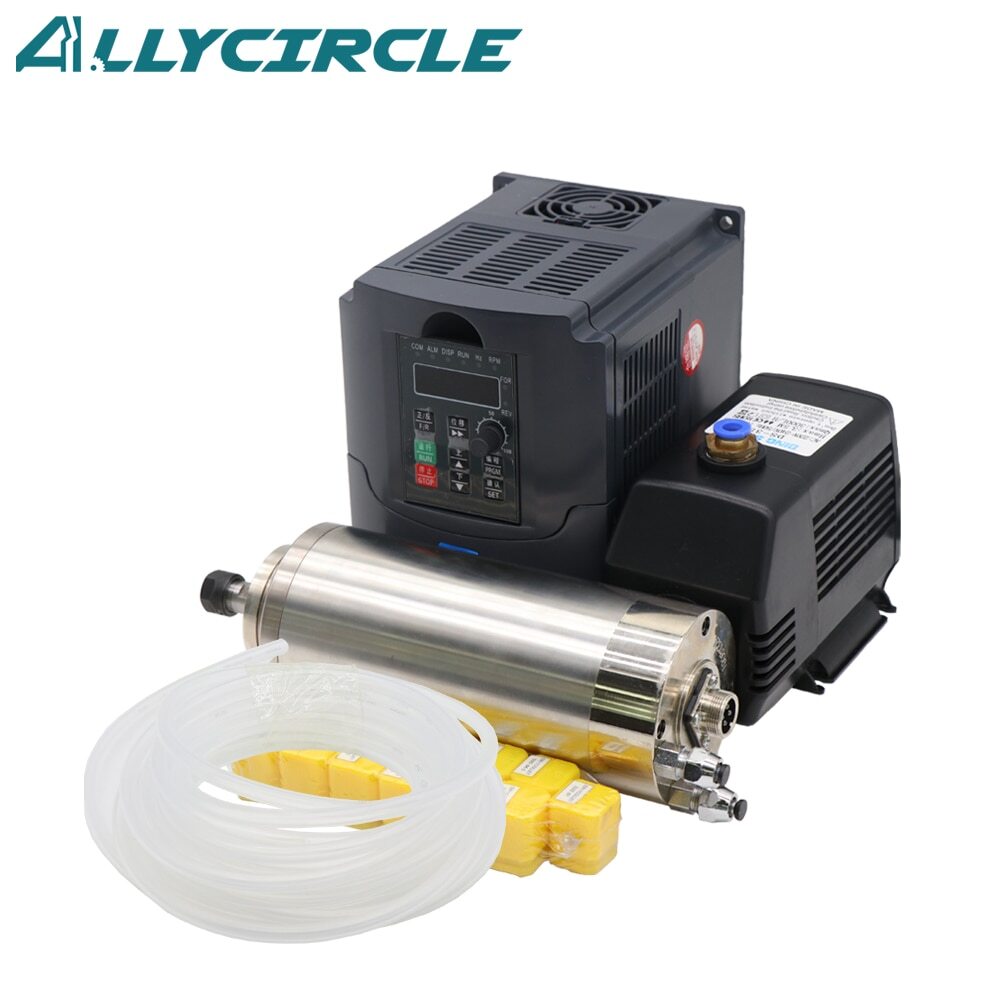
800W vs 1.5kW vs 2.2kW CNC Spindle: Pick the Right Wattage
Spindle wattage directly determines how much torque you have available at the cutter.
Table of Contents
- What Wattage Actually Controls
- 500–800W Spindles: Lightweight Option
- 1.5kW Spindles: The Hobbyist Standard
- 2.2kW Spindles: Production and Aluminum
- Machine Size and Spindle Wattage Table
- Power Delivery and Electrical Reality
- Collet Size and Bit Availability
- Speed/Torque Trade-off Chart
- Weight and Z-Axis Motor Sizing
- When to Buy What
- What We'd Buy
- Shop This Guide
- Related Articles
What Wattage Actually Controls
Power (watts) is torque × speed. A spindle with more wattage can deliver more torque at lower RPM, or more RPM at the same torque.
Practically: a 2.2kW spindle can push a 12mm diameter 3-flute end mill through hardwood at 200mm/min depth of cut. An 800W spindle can manage maybe 3mm depth on the same bit. That's the real difference.
500–800W Spindles: Lightweight Option
Typical specs:
- Wattage: 500–800W
- Weight: ~1.2kg
- Common collet: ER11 or ER16
- Typical max rpm: 24,000
- Cost: ~$100–120
Use cases:
- 3D printers with spindle attachment (SLA resin finishing)
- Sub-600mm machines (very light-duty)
- Soft materials only (wood, plastic, foam)
Real limitations: Hardwood gets slow. Forget aluminum. If you hit a knot in wood, the spindle stalls or chatters. These are fine for hobby engraving or light plastic work, not machining.
Z-axis impact: Minimal weight. A lightweight stepper can handle it.
1.5kW Spindles: The Hobbyist Standard
Typical specs:
- Wattage: 1.5kW
- Weight: ~2.1kg
- Common collet: ER16 or ER20
- Typical max rpm: 24,000
- Cost: ~$150–180
Use cases:
- MPCNC builds (wood, plastic, light aluminum)
- Hobby routers under 800mm
- Production wood work (multiple parts, consistent feeds)
This is the workhorse. You can push real feeds on hardwood. Aluminum is cuttable but requires conservative speeds (50–100mm/min on 3mm depth). You won't stall on knots or catch grain. Most hobby builders settle here because it's adequate for 95% of hobby work.
Z-axis impact: 2kg is noticeable. Your Z-axis needs a real stepper (NEMA 23 or equivalent servo), and rapids will be slower than with the 800W spindle. Budget for this.
VFD voltage: Can run on 110V household power (draws 14A under full load). Check your breaker capacity.
2.2kW Spindles: Production and Aluminum
Typical specs:
- Wattage: 2.2kW
- Weight: ~3.5kg
- Common collet: ER20 (sometimes ER25 on special models)
- Typical max rpm: 24,000
- Cost: ~$200–250
Use cases:
- Aluminum production (5+ mm depth at moderate feeds)
- Large format machines (over 800mm work area)
- Unattended production runs (torque reserve for sustained cuts)
- Larger surfacing bits (2"+ diameter for panel work)
The 2.2kW opens up capabilities. You can run 1/2" shank bits (ER20 collet) which have dramatically better rigidity than 1/4" shanks. Chatter reduces. Aluminum cuts that would stall a 1.5kW work fine. Wood surface finishing is clean (no chatter).
Z-axis penalty: 3.5kg is real weight. Your Z-axis motor needs to be oversized. A NEMA 23 Z-axis will have slower rapids with a 2.2kW spindle than with a 1.5kW. Some builders use NEMA 34 on the Z just to maintain snappy acceleration.
VFD voltage: Really wants 220V household power (9A at 240V). Running on 110V requires a 22A breaker and heavier wiring—not ideal. Check your shop's electrical before committing.
Machine Size and Spindle Wattage Table
| Machine Size | Work Area | Primary Material | Recommended Wattage |
|---|---|---|---|
| 3018 (stock) | 300×180mm | Plastic, soft wood | 800W |
| MPCNC 500mm | 500×500mm | Wood, soft plastic | 1.5kW |
| DIY router 600mm | 600×600mm | Hardwood, aluminum | 1.5kW |
| Production router 800mm | 800×800mm | Mixed (wood + aluminum) | 1.5–2.2kW |
| Large format 1000mm+ | 1000×1000mm+ | Aluminum, steel | 2.2kW or servo |
Power Delivery and Electrical Reality
110V household power (US standard):
- Safe continuous draw: ~12–15A per outlet
- 800W spindle: ~7A (fine)
- 1.5kW spindle: ~14A (borderline, check breaker capacity)
- 2.2kW spindle: ~20A (requires dedicated 20A+ circuit, marginal)
220V household power (common in garages):
- Safe continuous draw: ~20A
- 1.5kW: ~9A (plenty of headroom)
- 2.2kW: ~10A (comfortable)
If you're on 110V and considering a 2.2kW spindle, have an electrician run a 220V circuit first. Don't try to force a 2.2kW through household 110V wiring.
Collet Size and Bit Availability
Spindle wattage determines the standard collet:
- 800W: ER11 (up to 7mm shank) or ER16 (up to 10mm)
- 1.5kW: ER16 (10mm) or ER20 (13mm / 1/2" shank)
- 2.2kW: ER20 (13mm / 1/2" shank)
Why this matters: ER20 allows 1/2" shank bits. These are rigid, reduce chatter, and are the standard for aluminum and production work. 1/4" shank bits (ER16) are adequate but more prone to deflection under aggressive feeds.
If you plan to cut aluminum at all, plan for ER20. That usually means 1.5kW minimum.
Speed/Torque Trade-off Chart
Weight and Z-Axis Motor Sizing
The spindle weight directly affects your Z-axis stepper choice:
| Spindle Wattage | Typical Weight | Z-Axis Motor | Z Rapid Speed |
|---|---|---|---|
| 800W | 1.2kg | NEMA 17 or small NEMA 23 | 100–150 mm/sec |
| 1.5kW | 2.1kg | NEMA 23 | 80–120 mm/sec |
| 2.2kW | 3.5kg | NEMA 23 or NEMA 34 | 50–100 mm/sec |
If you upgrade a 1.5kW build to 2.2kW by just swapping spindles, your Z-axis will be slower and may stall under rapid acceleration. Budget for a Z-axis upgrade (another $30–50 for a better stepper or servo).
When to Buy What
800W: Only if budget is extremely tight (~$80 cost) and you know you're cutting foam, soft plastic, or doing very light engraving. Otherwise, save the $70 and get 1.5kW.
1.5kW: Default choice for 95% of hobby builds. Adequate for wood, plastic, and light aluminum. Standard collet options. Good Z-axis balance. Widely supported by the community. Buy this unless you have a specific reason not to.
2.2kW: If you're building a large machine (800mm+), cutting aluminum regularly, or running a small production service. Accept that your Z-axis will be slower and your VFD will need 220V power. The torque reserve is genuinely useful for hard materials.
What We'd Buy
First build, budget conscious: 1.5kW water-cooled spindle kit, ER20 collet, ~$200 total with VFD. Standard choice, proven across thousands of MPCNC and hobby router builds.
Large machine or aluminum focus: 2.2kW air or water-cooled, ER20 collet, ~$240 total. Heavier, requires 220V, slower Z rapids, but handles real material at production speeds.
Second spindle for the same machine: Buy the next size up to experiment with different materials. Many builders have a 1.5kW and a 2.2kW mounted on quick-change spindle plates.
Shop This Guide
| Item | Where | Link |
|---|---|---|
| 800W Spindle Kit | Vevor | 800W spindle kit on Vevor → |
| 1.5kW Spindle Kit | Vevor | 1.5kW spindle kit on Vevor → |
| 2.2kW Spindle Kit | Vevor | 2.2kW spindle kit on Vevor → |
| 1.5kW/2.2kW Spindle Sets | AliExpress | 800W/1.5kW/2.2kW spindle sets on AliExpress → |
| Huanyang VFD 1.5kW | Amazon | Huanyang VFD 1.5kW 110V on Amazon → |