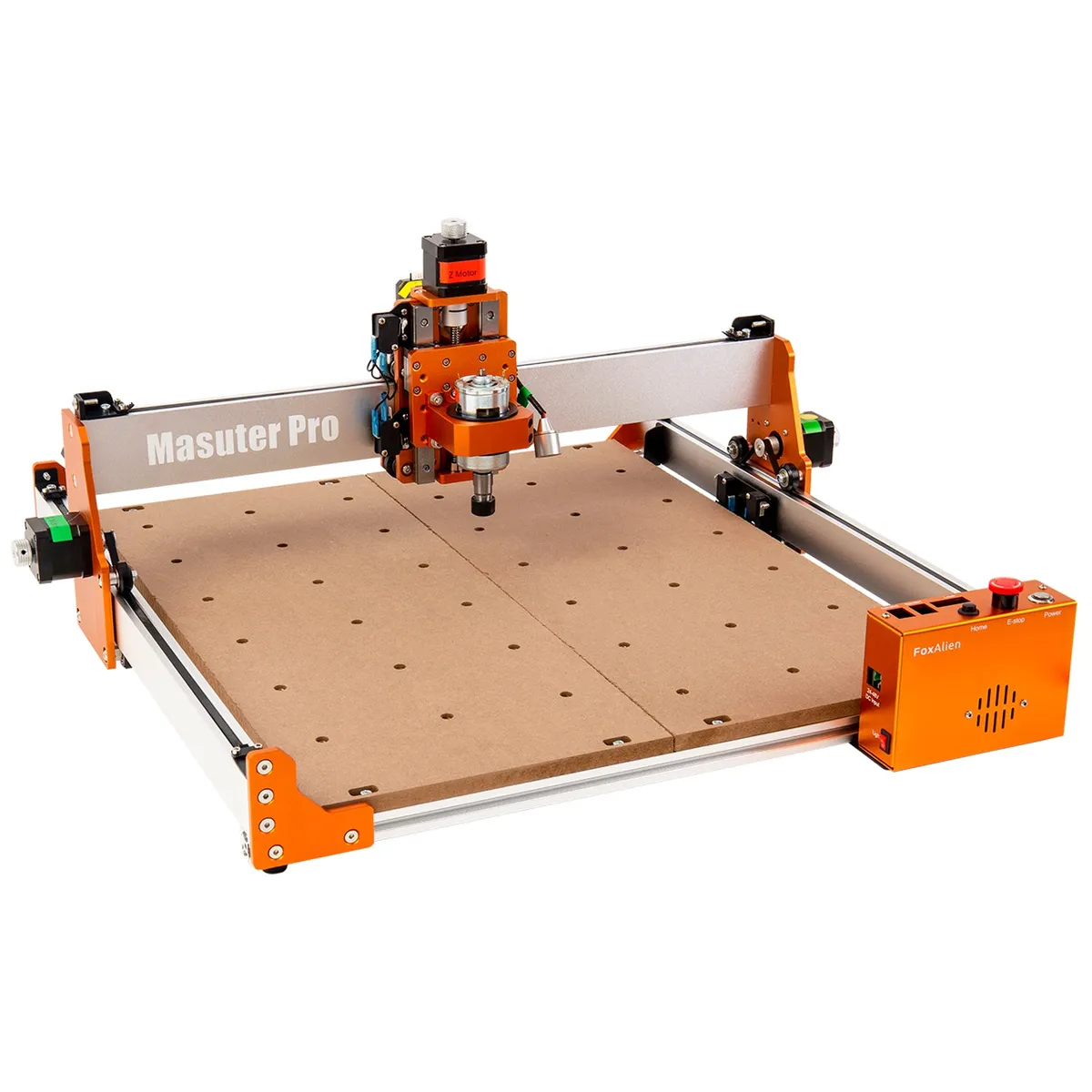
Cutting Hardwood on a Hobby CNC: Oak, Maple, and When Your Machine Isn't Ready
Your budget CNC can cut oak and maple. It can. But not the way you expect—not deep, not fast, not without careful setup.
Table of Contents
- Hardwood Reality Check
- What You Actually Need
- Chip Load: The Number That Ties Everything Together
- Recommended Settings by Species
- Grain Direction Matters: With vs Against
- Bit Selection for Hardwood
- The Heat and Burning Problem
- Workholding: Forces Are Real
- Climb Milling for Finish Passes
- Species-Specific Notes
- What We'd Buy
- Parts for this guide
- Related Articles
Hardwood Reality Check
Your budget CNC can cut oak and maple. It can. But not the way you expect—not deep, not fast, not without careful setup.
Hardwood and softwood are botanical groups, not fixed density or cutting-force classes. Species, moisture, grain, tooling and engagement all matter. A suitable hobby router can cut oak or maple; overloading it is a setup problem, not an inevitable property of NEMA23 motors.
This isn't a dig at hobby machines. It's reality: hardwood requires more rigidity, more spindle power, and more respect for speeds and feeds than softer materials. Get it wrong and you're breaking bits, stalling the spindle, or marring the finish.
Get it right and the detail is worth it.
What You Actually Need
Absolute minimum:
- Motors and drives capable of the planned cut; NEMA17 machines can also cut wood with suitable settings
- A suitable router or spindle with sharp tooling and cutting engagement matched to its power
- A rigid mount, sound bearings and a clean, correctly sized collet; a trim router can be suitable
- Workholding sized for the part and cutting forces; verify adhesion or clamp restraint before cutting
A lighter machine needs lighter engagement, but V-wheel and trim-router designs can cut hardwood. Assess the complete machine, cutter and toolpath rather than ruling out a whole class by spindle label.
The best hobby CNC for hardwood is something like:
- PrintNC: Full rigidity, excellent spindle mounting, widely available hardwood success stories
- Onefinity Woodworker: Industrial spindle mount, VFD-ready, proven with hardwood
- Shapeoko 5 Pro: already uses ballscrews on every axis and supports a trim router or suitable VFD spindle
- IndyMill: a DIY gantry-router option; check the build and tooling against your intended work
Chip Load: The Number That Ties Everything Together
Chip load = feed rate / (RPM × number of flutes)
Choose chip load from the exact cutter's data for the material, diameter and engagement; there is no single hardwood range.
Arithmetic example only: assume 18,000 RPM, two flutes and a selected chip load of 0.035 mm per tooth:
Feed rate = 0.035 × 18,000 × 2 = 1,260 mm/min
The arithmetic gives a feed rate; choosing a suitable chip load still requires cutter data and a trial on your machine.
Too little chip load can cause rubbing, heat and premature wear
Excessive chip load or engagement can cause deflection, chatter or breakage
Check chip load alongside rigidity, tool condition, grain and workholding when diagnosing a poor cut.
Recommended Settings by Species
| Wood Species | RPM | Feed (mm/min) | DOC (mm) | Notes |
|---|---|---|---|---|
| Oak | Use the cutter's specified RPM | Calculate from chip load and flute count | Match engagement to tool and machine | Coarse grain, variable hardness |
| Maple | Use the cutter's specified RPM | Calculate from chip load and flute count | Match engagement to tool and machine | Maple species differ; avoid rubbing with a dull cutter |
| Walnut | Use the cutter's specified RPM | Calculate from chip load and flute count | Match engagement to tool and machine | Forgiving, cuts cleanly, machines beautifully |
| Cherry | Use the cutter's specified RPM | Calculate from chip load and flute count | Match engagement to tool and machine | Cherry can machine cleanly; check grain and burning |
| Ash | Use the cutter's specified RPM | Calculate from chip load and flute count | Match engagement to tool and machine | Hard but clean, good surface finish |
Test on scrap, change one setting at a time and check heat, edge quality and machine load.
Grain Direction Matters: With vs Against
Wood has grain direction. Cutting "with the grain" is easier; cutting "against the grain" causes tearout.
Strategy:
- Rough with the grain and edge support in mind, leaving enough material for a finishing pass
- Final pass: test climb or conventional direction with light radial engagement and choose the better finish for the local grain
A light finishing pass can improve the edge, but the result depends on grain, cutter sharpness and toolpath direction.
Climb milling caveat: It requires very tight backlash control. If your machine has loose ballscrews or worn nuts, climb milling can cause the bit to dig in. Test on scrap first.
Bit Selection for Hardwood
Upcut spiral, solid carbide, sharp edges is the standard.
Number of flutes:
- 1-flute: wood-specific geometry can suit a limited-feed machine; check the cutter's intended materials
- 2-flute: Workhorse for wood, balance of speed and surface finish
- 3-flute: at the same RPM and chip load, more flutes require a higher feed; geometry and rigidity determine the finish
Edge sharpness matters more in hardwood than in soft materials. A dull bit causes burning and excessive heat. Replace bits more frequently than you'd think.
The Heat and Burning Problem
Smoke = bad. Black discoloration = bad. These mean:
- Feed rate is too slow (rubbing instead of cutting)
- Bit is dull
- Spindle speed is too high relative to feed for the intended chip load
- Dwell or repeated chip cutting is heating a small area
If you see smoke, stop the cut and investigate before restarting. Check tool sharpness, chip clearing and chip load. Where rubbing is the cause, simply slowing the feed can make the problem worse.
Clean hardwood cuts should smell like fresh-cut wood, not burnt.
Workholding: Forces Are Real
Hardwood generates significant cutting forces. Tape alone often isn't enough. Use:
- Clamps at strategic points (near areas being cut)
- Double-sided tape (provides some holding power, not the only method)
- Cauls (sacrificial wood pieces under clamps to distribute pressure)
Test workholding on scrap. If the piece shifts during a cut, everything goes wrong.
Climb Milling for Finish Passes
After roughing with conventional milling, a single light climb pass can transform surface quality:
- Roughing: choose direction and engagement for the grain, cutter and machine, leaving controlled finishing stock
- Finishing: use a light radial allowance and the cutter's appropriate feed, checking the result on scrap
A finishing pass removes a controlled amount of stock with lower engagement. Climb direction describes tooth motion relative to feed; it can run with, across or against the wood grain.
Requirement: Tight backlash control and proven machine rigidity. Test on scrap first.
Species-Specific Notes
Oak: Coarse grain, variable hardness within the same board. Grain direction is very visible. Sand and finish carefully—raised grain is annoying. Good learning material because it's forgiving on cuts.
Maple: properties vary between species. Hard maple can be demanding, and a sharp cutter with suitable chip load helps avoid burning. Test the actual stock before applying the same settings to a whole batch.
Walnut: The hobbyist's favorite. Machines beautifully, cuts cleanly, finishes dark and rich. Surprisingly forgiving on speeds/feeds. If you're going to try hardwood, start here.
Cherry: Similar to walnut but slightly easier. Beautiful deep red finish. Worth the effort.
What We'd Buy
For hardwood CNC work:
- Solid carbide 1/4" upcut spiral ($20–30): Get at least two
- 1/8" carbide upcut ($18–25): For detail and finer pockets
- 2-flute finishing bits ($20–30): For final passes
- Clear, dry hardwood offcuts for test cuts: choose stock with predictable grain before tackling figured or irregular boards
- A caliper for stock thickness and a reliable tool-zero method: program pass depth in CAM
Parts for this guide
If you are buying after reading this, these are the specs to look for.
| Part | What to buy | Where to look |
|---|---|---|
| Carbide upcut roughing bit The reader needs a sharp general-purpose cutter for hardwood pockets and profiles. | 1/4 in diameter, 1/4 in shank, two-flute solid-carbide upcut intended for solid wood; choose only the cutting length required and use a matching collet. | |
| Small detail cutter The reader needs a smaller cutter for details the larger bit cannot reach. | 1/8 in cutting diameter solid-carbide wood spiral, with a shank that exactly matches an available collet; keep stickout and cutting length short. | |
| Downcut finishing bit The reader needs control of top-edge fuzz and tearout on visible hardwood surfaces. | 1/4 in diameter, two-flute carbide downcut for solid wood, with sufficient flute length and a compatible shank; use where a clean top edge matters and chips can clear. | |
| Low-profile hold-down clamps The reader needs firm restraint without denting the work or blocking the finishing toolpath. | Clamps and bolts matching the table's T-track or insert thread, with support pads and heights checked against the cutter, collet and retract path. |
"Search" buttons open a search for that exact spec, so compare listings against it before buying. Some links earn us a commission at no extra cost to you (disclosure).