CNC Frame Materials — Aluminum Extrusion vs Steel vs MDF
A rigid CNC frame is not a luxury—it's the difference between a machine that works and one that frustrates you into giving up.
Table of Contents
- The Real Trade-Off: Deflection Visible in Every Cut
- MDF and Plywood: Cheap, Surprisingly Rigid, Moisture-Sensitive
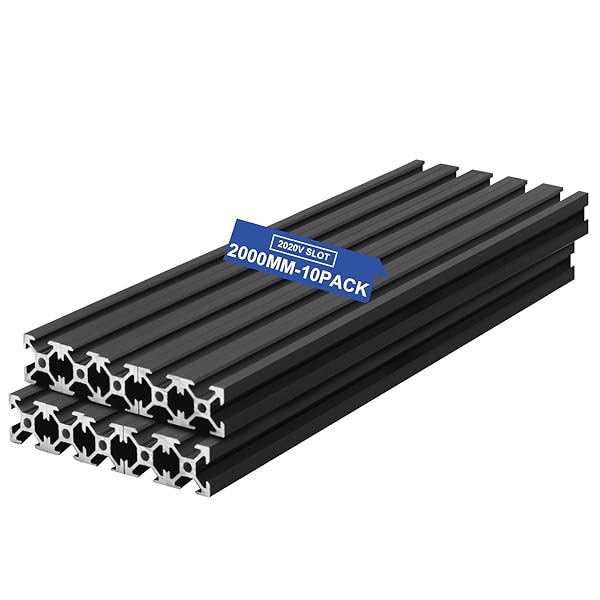
- Aluminum Extrusion: Modular, Adjustable, Requires Bracing
- Welded Steel: The Rigidity Kingpin
- PrintNC's Bolted Steel Approach: No Welding Required
- Epoxy Granite: The Emerging DIY Option
- Rigidity and Cost Comparison Chart
- Material Comparison Table
- How to Choose
- Real-World Examples
- The Verdict: Hybrid Approach for Most Hobbyists
- Parts for this guide
- Related Guides
The Real Trade-Off: Deflection Visible in Every Cut
A rigid CNC frame is not a luxury—it's the difference between a machine that works and one that frustrates you into giving up.
Frame deflection changes the tool's position relative to the workpiece, affecting dimensions and finish. Gantry sag can change cutting depth, while sideways movement can leave errors on the part. The effect depends on load and machine geometry; a single deflection number does not predict chatter or surface finish. Build stiffness into the structure.
MDF and Plywood: Cheap, Surprisingly Rigid, Moisture-Sensitive
The appeal: Sheet materials are inexpensive and easy to machine into a braced frame. BobsCNC's E3 demonstrates a plywood construction, not an MDF one. MDF can be useful for budget builds, but stiffness depends on panel geometry and joints, not simply using 3/4-inch sheet.
Why MDF actually works in some cases:
- High damping (absorbs vibration energy naturally)
- Incredibly easy to modify (pocket holes, drilling, routing)
- Lightweight (easier to move the machine)
- Dimensional stability depends on keeping moisture content reasonably constant.
Rigidity depends on the panel layout, bracing, joints and load. There is no useful MDF-to-extrusion stiffness ratio without defining both frame designs and comparing them under the same conditions.
The catch #1: Moisture. MDF is compressed wood fiber bonded with urea formaldehyde glue. In humid environments (basements, shops near water, coastal areas), it swells. A 0.5mm swell in your frame changes Z-zero. Over time, joint integrity degrades.
The catch #2: Joint design. MDF can hold screws well when the screw type, pilot hole and edge distances are suitable. Avoid crushing the board by overtightening, and use joints designed for the loads rather than assuming pocket screws will solve every connection.
The catch #3: Repair. Moisture damage or damaged fastener holes may require replacing panels and realigning the machine. Plan access to the joints and rail mounts so repairs are practical.
Who should use it: Budget-conscious builders with a dry workshop who will inspect joints and protect the frame from moisture.
Cost: $50–150 for a complete 600×600mm frame.
Aluminum Extrusion: Modular, Adjustable, Requires Bracing
The appeal: You can order extrusion online, bolt it together, and start routing the same day. No welding. No fabrication skills. Reconfigurable—you can move rails around.
Why it's the hobby standard:
- Modular and reconfigurable
- Fast assembly
- Infinite fastening options (T-nuts, bolt holes)
- Doesn't rust
- A damaged beam may be replaceable; inspect rail and wheel running surfaces before continuing to use it.
The fundamental problem: Long, lightly supported members and flexible joints deflect. Aluminum's elastic modulus is lower than steel's, but so is its density; stiffness per unit weight also depends strongly on cross-section and frame design. You can:
- Use larger extrusion (cost goes up)
- Add diagonal cross-bracing (complexity goes up)
- Accept more deflection (chatter and finish suffer)
Choosing an extrusion: Compare the supplier's section properties in the actual loading direction, then account for span, gantry weight and cutting forces. A 4080 profile is not an automatic solution for every long span.
Best practice: Use aluminum extrusion with steel cross-bracing. A 4080 primary beam + steel diagonal braces = excellent rigidity without full steel fabrication.
Documented example: Ooznest's WorkBee uses aluminum C-Beam members and plate connections. Its assembly manual does not describe a 2040 gantry reinforced with 3/4-inch steel pipe. Follow the actual design rather than assuming every OpenBuilds-derived machine uses the same frame.
Failure mode: An undersized or poorly supported gantry can sag under its own weight and the spindle load. Measure or calculate the complete assembly before choosing reinforcement; a brace only helps loads that its geometry and connections can carry.
Cost: $300–600 for a 600×600mm frame (extrusion alone).
Welded Steel: The Rigidity Kingpin
The appeal: A welded rectangular steel tube frame is dramatically stiffer than aluminum extrusion of similar cross-section.
Physics: Steel's elastic modulus is about three times aluminum's, and its density is also about three times higher. That does not make a steel frame four or five times stiffer per unit weight. Member geometry and joint design determine the result; welding alone does not guarantee a rigid, accurate assembly.
Real-world consequence: Steel tubing can make a practical, stiff frame, but compare actual sections in the intended orientation. Tube dimensions, extrusion section properties, support conditions and load all matter; a smaller steel tube does not automatically outperform a larger aluminum profile.
The catch #1: Welding. You need welding skills or access to a welder. This is a barrier for many hobby builders.
The catch #2: Weight. Steel is denser than aluminum, but the mass of a complete frame depends on how much material the design uses. Compare the actual cut lists if portability matters.
The catch #3: Stress relief. If precision matters (grinding, precision boring), welding introduces internal stresses that distort the frame. Professional shops stress-relieve after welding (heat-treating). Hobbyists often skip this. Solution: bolt-together steel frames (see below).
Failure mode: Corrosion. Protect exposed steel with an appropriate finish and inspect it in damp conditions. Keep coatings away from precision mounting interfaces unless the design specifically allows them.
Who should use it: Experienced builders, people with welding access, people building once and keeping the machine for 10 years.
Cost: $400–800 for materials + welding labor (or free if you DIY weld).
PrintNC's Bolted Steel Approach: No Welding Required
PrintNC sidesteps the welding barrier with bolted steel frames: rectangular steel tubing that is drilled, tapped and bolted together, with 3D printed drilling guides to put every hole in the right place. It works because:
- Rigidity of steel (steel is about three times as stiff as aluminum)
- No welding skills required (bolt-together assembly)
- Printed guides help locate holes; rail alignment and machine squareness still need checking.
- Stress-relief not needed (no heat-treating required)
How it works: rectangular steel tube (75 x 50 x 3 mm is the PrintNC V4 default) is cut to length, drilled and tapped through 3D printed guides, and bolted together with M6 bolts. The rails, ballscrew supports and spindle mount to steel or aluminum, not to plastic.
Trade-off: every hole is drilled and tapped by hand, so you need a drill, taps and patience. Have the steel cut to length by a supplier if you can.
Design intent: the PrintNC wiki describes the V4 Metalcutter preset as the choice for aluminum-focused machines, with dual carriages on every axis and larger rails and steel.
Cost: Allow roughly $600-1000 for the proposed bolted frame budget, then check the actual cut list and local quotes. The structure uses steel tubing and fasteners; printed drilling guides are assembly aids, not load-bearing frame joints.
Epoxy Granite: The Emerging DIY Option
What it is: Mineral aggregate mixed with a resin binder and cast into a mold. A suitable cured formulation offers good vibration damping. Precision mounting surfaces still require controlled tooling, replication or finishing; pouring the mixture does not automatically make it flat.
Why it's compelling: Mineral casting is an established machine-base material valued for damping. Its stiffness, density and required section size differ from cast iron. Similar machine performance requires a suitable design, not a universal one-third-weight substitution.
How to approach it: Choose a documented resin-and-aggregate system, design the mold and mounting inserts, and follow its mixing, compaction and curing instructions. Plan how the rail seats will be made accurate. Cure time and machining readiness depend on the formulation and conditions.
Trade-off: It's a one-off project. You can't adjust it afterward (unlike extrusion). And if it fails, you start over.
Cost: $200-400 is a rough materials allowance, with significant time needed for mold preparation, curing and accurate mounting surfaces. Use the chosen resin system's cure schedule.
Rigidity and Cost Comparison Chart
Here's an illustrative comparison:
Key insight: Bolted steel is worth considering when you want a stiff frame without welding. Compare complete designs, including their joints and rail supports, before calling one the best value. The material name alone cannot establish a machine's rigidity.
Material Comparison Table
| Material | Rigidity | Cost | Build Difficulty | Moisture Resistance | Weight | Adjustability | Best For |
|---|---|---|---|---|---|---|---|
| MDF/Plywood | Depends on panel geometry and bracing | $100 | Easy | Poor | Light | Excellent | Budget builds, prototypes |
| Aluminum Extrusion | Depends on profile, span and joints | $400 | Easy | Excellent | Medium | Excellent | Production hobby routers |
| Bolted Steel Tube | Depends on tube sections and joints | $700 | Medium | Fair (paint req'd) | Heavy | Good | High-precision machines, aluminum cutting |
| Welded Steel | Depends on tube sections and weld layout | $800 | Hard (welding) | Fair (paint req'd) | Heavy | Poor | Industrial-grade, one-off builds |
| Epoxy Granite | Depends on mix, section size and interfaces | $300 | Medium (messy) | Excellent | Very Heavy | None | Precision baseplates, experimental |
How to Choose
If you're building your first CNC and want to get cutting in a weekend:
Aluminum extrusion (2040 or 4080, depending on span). It's modular, forgiving, and you can upgrade later.
If you're on a tight budget and your workshop is dry:
MDF can suit a carefully braced budget frame. Use a documented joint design, keep the material dry and inspect the fastenings; sheet thickness and a monthly tightening routine alone do not ensure a sound machine.
If you want to cut aluminum and don't mind some complexity:
Consider a bolted steel tube frame such as PrintNC, or an extrusion design with adequate sections and joints. Judge stiffness from the whole machine and its measured performance rather than a fixed percentage assigned to a hybrid frame.
If you have welding skills and precision is critical:
Welded steel can work well if you can control fabrication distortion. Plan the rail mounting surfaces and their finishing, and assess whether stress relief is needed for the design and accuracy target.
If you're experimenting:
Epoxy granite is an option for an experimental base. Use a documented material system and plan the precision interfaces before casting; the moving gantry still needs its own stiffness and mass assessment.
Real-World Examples
BobsCNC E3: A plywood-frame router with SG20U bearings running on steel rail rods. It is a documented example of a sheet-wood machine, not a 3/4-inch MDF frame with aluminum extrusion rails.
WorkBee (Ooznest): An aluminum C-Beam router with plate connections. The frame and cutting area depend on the kit size; use the relevant assembly manual rather than assuming 2040 profiles, steel pipe braces or one standard work area.
PrintNC: bolted steel tube frame (75 x 50 x 3 mm default in V4), drilled and tapped through 3D printed guides. Built for aluminum and hardwood.
Tormach PCNC 440: A CNC mill with a cast-iron frame and table, hand-scraped hydrodynamic ways and adjustable gibs. Its construction is different from the welded steel router frames discussed here.
The Verdict: Hybrid Approach for Most Hobbyists
For a new builder: Start with aluminum extrusion (2040 or 4080). It's fast to assemble, proven, and modular. Add steel cross-bracing for rigidity. Total: ~$500–700, excellent results, no special skills.
For production or precision: Consider a well-designed bolted or welded steel structure if it suits your fabrication skills. Check the complete frame and rail mounting arrangement; neither construction method carries a universal stiffness multiplier.
For budget: MDF can work for a braced, dry-shop machine. Protect it from moisture, inspect the joints and replace damaged parts when necessary.
Aluminum extrusion with suitable bracing can be a practical hobby-router choice: modular, adjustable and possible to assemble without welding. Treat it as one design option, then check the member sizes, connections and rail support against the machine you want to build.
Parts for this guide
If you are buying after reading this, these are the specs to look for.
| Part | What to buy | Where to look |
|---|---|---|
| Structural aluminum extrusion Lets an extrusion-frame builder choose members from actual geometry and load requirements. | Profile matching the selected frame drawings, with supplier drawings and second moments of area for both bending axes; match slot series, lengths and fasteners before ordering. | |
| Extrusion gusset plates and matching fasteners Makes the extrusion joints and bracing concrete without assuming one bracket fits every slot. | Gusset plates with hole pattern, thickness, bolts and T-nuts matched to the selected profile system and frame drawings. | |
| Dial indicator and rigid mounting stand Checks rail alignment and relative tool-to-table movement after assembling the frame. | Indicator with 0.01 mm graduations, compatible rigid stand or clamp, and enough travel for the planned alignment checks; graduation is not an accuracy guarantee. |
"Search" buttons open a search for that exact spec, so compare listings against it before buying. Some links earn us a commission at no extra cost to you (disclosure).