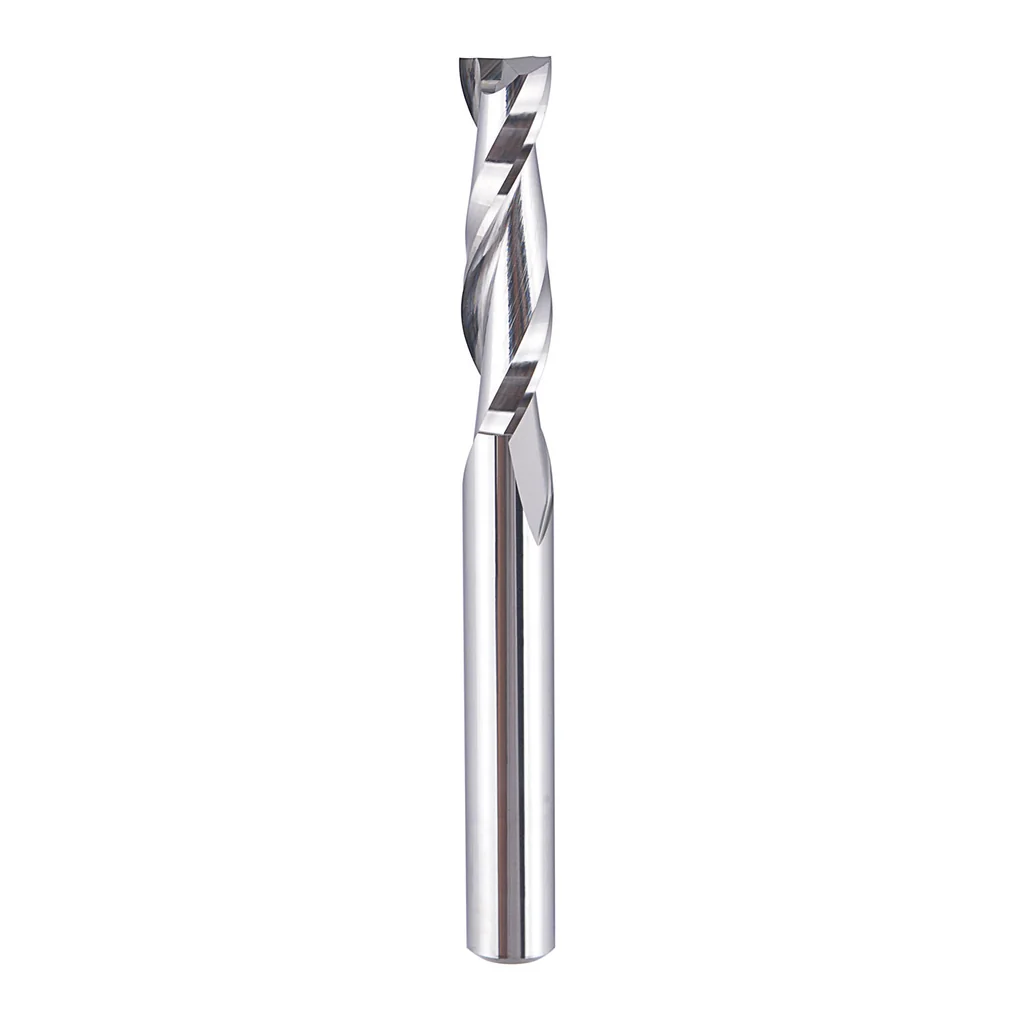
Upcut vs Downcut vs Compression End Mills: When to Use Each and Why
Every beginner eventually asks: "Which helix direction should I use?"
Table of Contents
- The Confusing Choice That Shouldn't Be Confusing
- Upcut Spiral: Pulls Chips Up
- Downcut Spiral: Pushes Chips Down
- Compression Spiral: Two Zones, One Bit
- When to Use Each: The Decision Tree
- Material-Specific Recommendations
- The Compression Bit Caveat
- Number of Flutes (2-Flute vs 3-Flute)
- Surface Finish Reality
- What We'd Buy
- Shop This Guide
- Related Articles
The Confusing Choice That Shouldn't Be Confusing
Every beginner eventually asks: "Which helix direction should I use?"
It's actually simple once you understand what each does. Let's break it down without the jargon.
Upcut Spiral: Pulls Chips Up
An upcut bit has a spiral that rotates like a spiral staircase going up. As it cuts, it literally pulls chips up and out of the cut.
Pros:
- Excellent chip evacuation
- Works great in pockets and cavities
- Preferred for deep cuts where chip space matters
- Better for aluminum (less recutting)
- Standard bit, cheapest option
Cons:
- Creates tearout on the top surface of the material
- Lifts fibers up, leaving a fuzzy or rough top edge
- Not ideal for veneered or painted surfaces
Downcut Spiral: Pushes Chips Down
A downcut bit has a spiral that goes the opposite direction. Chips get pushed down into the cut.
Pros:
- Gives a pristine, clean top surface (no tearout)
- Excellent for veneered plywood, laminate, painted surfaces
- Sharp edge on top where it matters visually
Cons:
- Chips pack into the cut (harder to evacuate)
- Not recommended for pockets deeper than 1–2 inches
- Requires better chip management (air blast helps)
- More expensive than upcut
Compression Spiral: Two Zones, One Bit
A compression bit is clever: upcut at the bottom (tip), downcut at the top. It's designed specifically for through-cuts where you want clean surfaces on both top and bottom.
How it works:
- The upcut zone at the tip evacuates chips downward
- The downcut zone at the top prevents tearout as the bit exits
- The two zones overlap in the middle
Pros:
- Clean top AND clean bottom surface on through-cuts
- Reduces tearout dramatically on full-depth cuts
- The "spoilboard bit" for sheet goods work
Cons:
- Must be used at sufficient depth to engage both zones
- Won't work properly as a shallow pocket bit
- More expensive than upcut or downcut alone
- Slower feed rates than upcut
When to Use Each: The Decision Tree
Upcut
- Pockets and cavities
- Through-cuts where bottom surface doesn't matter
- Aluminum (always)
- Deep cuts in solid material
- Any application where chip evacuation is critical
Example: Cutting a pocket in MDF for a drawer, cutting 3D profile in hardwood, cutting aluminum plate
Downcut
- When the top surface finish is critical
- Veneered plywood or laminate where you can't have tearout
- Shallow cuts on finished surfaces
- Painted or stained surfaces where top appearance matters
Example: Cutting edge banding on plywood, shallow surface carving on stained wood, cutting a hole in laminate countertop
Compression
- Through-cuts in plywood (both sides need to be clean)
- Cutting sheet goods for final use without cleanup
- Production runs where surface quality matters on both sides
- Full-depth carving where edges are visible
Example: Cutting parts for a box from plywood, through-cuts in MDF panels for assembly, sheet goods that will be visible from both sides
Material-Specific Recommendations
| Material | Best Choice | Why | Alternative |
|---|---|---|---|
| MDF | Upcut | Dust management, less fuzz | Compression if through-cutting |
| Solid hardwood | Upcut | Standard for pockets, carving | Downcut for finish passes on surfaces |
| Plywood (through cuts) | Compression | Clean top and bottom | Upcut + separate downcut pass |
| Veneered plywood | Compression or Downcut | Prevent veneer tearout | Upcut with very shallow final pass |
| Laminate | Downcut | Top surface is visible, must be clean | Not recommended: difficult to manage |
| Aluminum | Upcut always | Recutting is the enemy | Single-flute bit is more important than helix |
| Acrylic | O-flute (doesn't matter) | Helix matters less than bit design | Single-flute O-flute standard |
| Soft plastics (HDPE) | Upcut preferred | Good chip space, less melting | Downcut works but packs chips faster |
The Compression Bit Caveat
Critical: A compression bit only works properly if it engages both the up and down zones. If your DOC is so shallow that you're only cutting in the upcut zone, you've essentially got an upcut bit that cost more.
Example: Using a 1/4" compression bit with only 0.5mm DOC = you're only using the upcut portion. Waste of money.
Use compression bits for:
- Full-depth or near-full-depth through-cuts
- Deep pockets where you want clean edges
Don't use them for:
- Shallow surface carving
- Small detail work
- Any situation where DOC is less than 25% of the tool's cutting length
Number of Flutes (2-Flute vs 3-Flute)
Flute count is separate from spiral direction:
- 1-flute: Massive chip space, plastics, softer materials
- 2-flute: Workhorse for wood, aluminum, all-purpose
- 3-flute: Excellent for hardwood finish passes, slightly slower feeds
You can get 2-flute upcuts, 2-flute downcuts, 3-flute compression bits, etc. Choose both:
- Spiral direction (up/down/compression)
- Number of flutes (1/2/3)
For most hobbyists:
- Standard work: 2-flute upcut
- Fine finishing in hardwood: 2-flute or 3-flute downcut as final pass
- Sheet goods: Compression bit
Surface Finish Reality
Upcut bits leave toolmarks on the top surface. This is fine if you're painting, staining, or sanding anyway. It's not fine if you need a gloss-finish-ready top surface.
If top surface finish matters and you don't have compression bits:
- Rough and intermediate passes with upcut
- Final pass with downcut or compression on top surface only
- This gives you clean edges and good chip evacuation
Slightly longer machining time, dramatically better results.
What We'd Buy
For a beginner's bit collection:
- 2-flute upcut 1/4" ($12–20): Your main workhorse
- 2-flute downcut 1/4" ($15–25): For finishing passes and surface work
- 1/4" compression bit ($18–30): For plywood through-cuts
- 1/8" upcut ($12–18): Detail work
- 60° V-bit ($12–20): For text and engraving
This covers 95% of hobby projects.