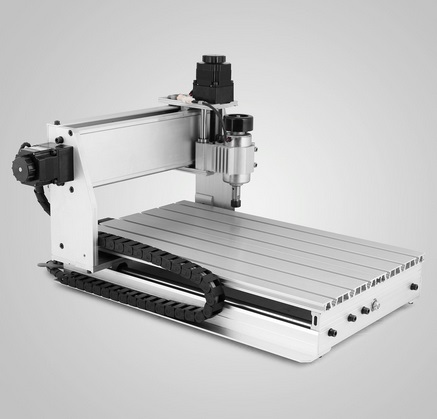
IndyMill Build Guide: An Open-Source Gantry CNC Router
Nikodem Bartnik designed IndyMill as an open-source gantry CNC router and documented the build in videos, downloadable files and a written assembly guide.
Table of Contents
- The IndyMill Design Philosophy
- Build Documentation: YouTube as Primary Source
- Specifications & Reality
- NEMA23 Motors and Matching Drivers
- Building the Frame and Metal Plates
- Spindle Selection
- Software & Control
- Accuracy Expectations
- The Community & Resources
- When to Choose IndyMill Over PrintNC
- When PrintNC is Better
- Verdict
- Shop This Guide
- Related Articles
Nikodem Bartnik developed IndyMill as an upgrade to his Dremel CNC. It is an open-source gantry router with an aluminum extrusion frame, metal plates and linear guides, with a documented path from a 500W spindle to a 1.5kW spindle.
IndyMill moves a gantry over a stationary workpiece. Its rigidity depends on the frame, rails, joints, spindle mounting and build size. Compare completed machines and measured cuts before assuming a stiffness or finish advantage over another DIY router.
The IndyMill Design Philosophy
IndyMill uses aluminum profiles and cut metal plates to support a moving gantry. MGN12 rails guide the axes. Three SFU1605 ballscrews drive X and the two sides of Y, while a trapezoidal leadscrew drives Z. Four NEMA23 motors move the tool over a fixed bed.
Like PrintNC and MPCNC, IndyMill uses a gantry-router layout:
- Z-axis: linear guides and a leadscrew on the moving gantry
- Workflow: the machine moves the tool in X, Y and Z over the stationary work
- Spindle: a vertical tool orientation, with chip evacuation arranged around the cut
- Workholding: secure the stock to the fixed bed and keep clamps clear of gantry travel
The build combines metal plates, aluminum extrusion and printed bearing and nut holders. X and Y use ballscrews; Z uses a trapezoidal leadscrew. The designer publishes the parts list and files so builders can reproduce or adapt the machine.
Build Documentation: YouTube as Primary Source
Nikodem's videos show the build, but they are not the only documentation. His project page supplies a parts list, DXF and STL files, and an optional paid assembly PDF. Use those references alongside the videos.
This means:
- Pro: you can watch exactly what he did, see assembly challenges in real time, understand design intent
- Con: check that your parts and any upgrades match the revision shown in the instructions
Use the official parts list as a checklist and the designer's videos to understand assembly. Identify the exact revision and modification when asking other builders for help.
Specifications & Reality
| Aspect | IndyMill | PrintNC (for comparison) |
|---|---|---|
| Work Area | About 520 x 400 mm | Build-dependent; check the selected PrintNC BOM |
| Z Clearance | About 115 mm Z working range; usable stock height depends on tooling | Build-dependent; allow for tooling and spoilboard |
| Frame construction | Aluminum profiles and cut metal plates | N/A (gantry design) |
| Linear Rails | MGN12 rails with MGN12H blocks | Check the selected PrintNC version's BOM |
| Ballscrews | SFU1605 on X and both sides of Y; trapezoidal Z leadscrew | All three axes typical |
| Motors | Four NEMA23 motors, including two on Y | NEMA23 typical |
| Spindle | 500W original spindle; documented 1.5kW upgrade | Match spindle power, mass and mount to the selected build |
| 3D Printed Parts | Printed bearing blocks and nut holders | Yes (mostly convenience parts) |
| Build Cost | $600–1,200 | $800–1,500 |
| Assembly Time | Depends on sourcing, printing and experience | Depends on sourcing, printing and experience |
| Z-Axis Stiffness | Depends on gantry assembly and build dimensions | Depends on the selected build and assembly |
| Best For | Aluminum milling, precision parts, PCB work | Aluminum + larger work area |
The standard IndyMill is a medium-size gantry router. Choose it for its documented components and build process, then check the work envelope and cutting demands of your projects. A different DIY router may suit another size or workload better.
NEMA23 Motors and Matching Drivers
Follow the published build with four NEMA23 motors and compatible external drivers. Motor torque must be matched to screw lead, moving mass, acceleration and cutting load. A gantry has no inherent mechanical advantage over a column mill; the transmission determines that.
Cost: $35–50 per motor from AliExpress (StepperOnline) or $60–80 from Amazon. NEMA23 is the baseline. Budget accordingly.
Building the Frame and Metal Plates
Build the frame from the specified aluminum profiles and metal plates. The project supplies DXF files for 6 mm plates and two 8 mm Z rail supports. Printed parts hold bearings and drive nuts; use the official files and check their fit.
Before ordering fabricated parts:
- Use the published plate drawings and specified material thicknesses
- Check hole dimensions and tapping requirements before assembling the bolted frame
- The designer sells steel plate kits if you prefer to buy the fabricated parts
Spindle Selection
Spindle choices documented by the designer:
- The original build uses a 500W spindle; the designer later upgraded to 1.5kW with a matching inverter
- Dremel or rotary tool = possible for very light cuts, but undersized
- A trim router needs a suitable mount and a check of moving mass and available clearance
Choose cooling and operating speed from the spindle manufacturer's instructions. Arrange chip clearing and any coolant around the tool and workholding; the vertical orientation is normal for CNC routers.
Software & Control
IndyMill builders use:
- The original control system uses GRBL on an Arduino UNO with an IndyShield; FluidNC is an alternative with compatible hardware
- Mach3 (some builders): proprietary, steeper learning curve, unnecessary for a machine this size
- LinuxCNC (niche): powerful but complex
The firmware choice doesn't matter much if you pick GRBL/FluidNC. Board options:
- ESP32-based: choose a CNC board with suitable I/O and external-driver connections for the selected firmware
- Arduino UNO plus IndyShield: the documented interface to external stepper drivers
- Check the controller schematic, firmware support and driver signal compatibility before buying
Budget $50–80 for a solid controller setup. Don't cheap out.
Accuracy Expectations
A properly tuned IndyMill:
- Repeatability: measure your completed build before assigning tolerances
- Surface finish: use cutting data matched to the tool and the spindle's permitted speed range
- Cut speed: calculate from the cutter's chip load, flute count and RPM, then account for engagement
Treat accuracy and finish as properties of a measured build and process. Assembly, backlash, runout, workholding and cutting forces all matter; a design name alone does not guarantee a tolerance.
The Community & Resources
- Nikodem's YouTube channel: the source
- Official project page: download the complete DXF and STL files
- GitHub: NikodemBartnik/IndyMill, the designer's repository
Start with the designer's documentation and identify your build revision when looking for help. Modified machines can differ substantially from the standard BOM.
When to Choose IndyMill Over PrintNC
- You want to build a documented gantry router for wood, plastics and suitable light aluminum work
- The standard working area of about 520 x 400 x 115 mm suits your projects
- You want a fixed work bed with a gantry moving the tool
- You like having videos, free design files and an optional written assembly manual
- You are prepared to align and measure a DIY machine before setting tolerances
When PrintNC is Better
- You need a different work envelope or frame design: compare the chosen PrintNC build with IndyMill's standard dimensions
- Compare the actual assembly instructions and BOM for each version before choosing
- You might want to upgrade to larger cutting: PrintNC's ceiling is higher
- Compare actual travel speeds using the chosen drives, motors and controller settings
Verdict
IndyMill is an open-source gantry CNC router with a standard working area of about 520 x 400 x 115 mm. Its official parts list, downloadable files, videos and optional written manual make it a documented DIY option. Precision and aluminum performance depend on the completed build and cutting setup.
Expect to source or buy the metal plates, assemble the extrusion frame, align rails and screws, and wire compatible electronics. Welding a machine column is not part of the published build. Budget time for setup and test cuts.
Choose it if its gantry layout and work envelope suit your projects and you want to build and tune the machine yourself. Read the official parts list and assembly information before ordering.
Shop This Guide
| Component | Source | Notes |
|---|---|---|
| IndyMill Plans | Printables.com (search: IndyMill) → | Free, includes all 3D print files and dimensions |
| MGN15 Rail Sets | C0 preload, you'll need 3× rails + 6× blocks | |
| Ballscrews (RM1605) | Matched set of 3 typical; budget ~$80–100 | |
| NEMA23 Motors | Amazon: StepperOnline NEMA23 → | 2–3Nm, 4× motors required, ~$40–80 each |
| 800W Spindle (VFD) | Vevor → | Water-cooled ceramic bearing, ~$120–150 |
| Steel Tube (Column) | Local steel supplier | 25×25mm or 30×30mm 0.065" wall, ~2–3 meters |
| Nylon 3D Filament | Amazon: Nylon Filament → | 1–2kg typical for all brackets; print on heated bed |
| FluidNC Controller | ~$30–50, includes stepper drivers and spindle output |
Parts for this guide
If you are buying after reading this, these are the specs to look for.
| Part | What to buy | Where to look |
|---|---|---|
| MGN12 rail and carriage set The builder needs the full set of linear guides before aligning the gantry and Z carriage. | Standard build: two 650 mm, two 600 mm and two 200 mm MGN12 rails, with 12 matching MGN12H blocks total; verify block interchangeability with the rail supplier. | |
| SFU1605 X and Y screw set The builder needs three correctly machined screws to drive X and both sides of the gantry. | One 650 mm and two 600 mm SFU1605 screws with matching nuts; end machining must match the IndyMill bearing and coupler drawings. | |
| External stepper drivers The four motors need suitable external drivers to connect to the controller. | Four step/direction digital drivers compatible with the selected NEMA23 phase current and 36 V DC supply; use the DM542-class BOM or designer's DM556 upgrade and check the exact maker datasheet. | |
| Aluminum frame profiles The builder needs profiles cut to the standard frame dimensions before fitting plates and rails. | 20 x 40 mm: two 600 mm and two 666 mm lengths; 20 x 80 mm: two 600 mm lengths; match slot and fasteners to the official drawings. | |
| Motor couplers The X and dual Y motors need couplers that fit their shafts and the screw ends. | Three flexible shaft couplers, 8 mm to 10 mm for the BOM motors and machined screw ends; measure both shafts before ordering. |
"Search" buttons open a search for that exact spec, so compare listings against it before buying. Some links earn us a commission at no extra cost to you (disclosure).