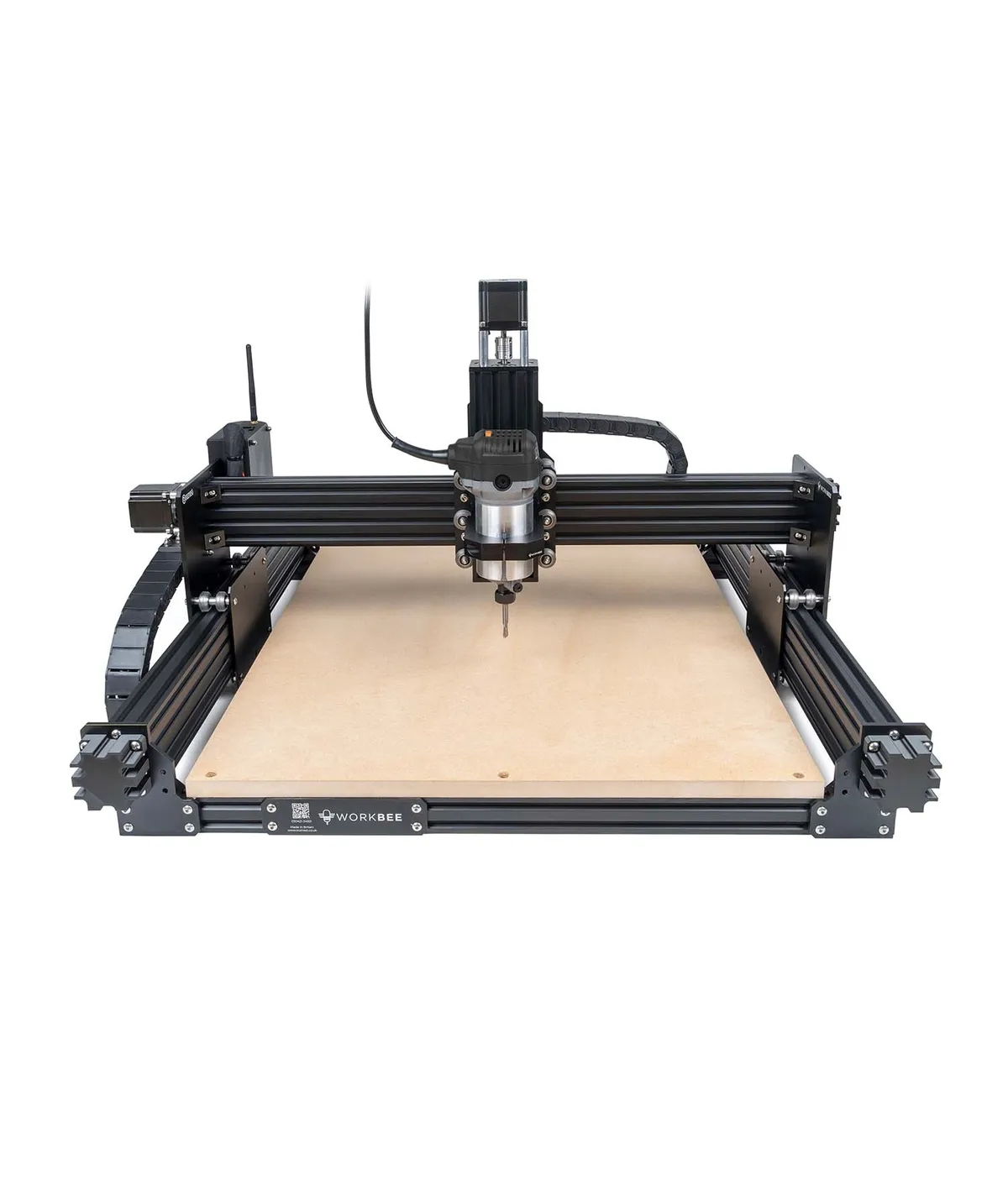
WorkBee CNC Guide: Ooznest Z1+, Earlier Versions and Compatible Kits
Ooznest designed the WorkBee around aluminum extrusion, V-wheels and screw or belt drives depending on the version. Identify the exact kit before comparing travel, electronics and upgrade options.
Table of Contents
- V-Wheel Carriages and Adjustment
- Available Sizes & Specifications
- The Comparison: WorkBee vs. LEAD 1010
- Specifications & Cutting Reality
- Frame Material & Assembly
- Spindle & Drive
- Controller & Software
- The Upgrade Path
- WorkBee vs. MPCNC vs. PrintNC
- European Availability & Shipping
- When to Choose WorkBee
- When to Choose Alternatives
- Verdict
- Shop This Guide
- Related Articles
WorkBee uses V-wheel carriages that engage opposing tracks on aluminum extrusion. Correct wheel adjustment and screw alignment matter to performance. Compare the actual WorkBee and LEAD carriage assemblies; neither is accurately described by the claimed four-wheel-versus-two-wheel story.
WorkBee has official assembly documentation and a range of original and third-party kits. Check the supplier, hardware revision and support available for the particular package.
V-Wheel Carriages and Adjustment
WorkBee carriage setup:
- V-wheels engage opposing tracks on the extrusion
- Eccentric spacers adjust wheel contact
- Adjust for smooth travel without carriage play
- Check the complete structure, including span, joints and Z extension
Correctly adjusted wheels help the carriage move without play. To compare machines, inspect the whole structure and use matched cutting or deflection tests rather than counting wheels.
Available Sizes & Specifications
WorkBee comes in several sizes:
| Size | Work Area | Cost (kit) | Use Case |
|---|---|---|---|
| 750×750 | 520 x 520 mm, Ooznest Z1+ | $600–900 | Small to medium hobby work |
| 1000×1000 | 770 x 770 mm, Ooznest Z1+ | $800–1,200 | Medium shop work, semi-pro |
| 1500×1500 | 1270 x 1270 mm, Ooznest Z1+ | $1,200–1,800 | Larger panels, furniture-scale |
Choose size from the real cutting area, footprint and planned parts. Allow room around the machine for access, workholding and dust hoses.
The Comparison: WorkBee vs. LEAD 1010
Both are V-slot aluminum frame routers. Both are well-documented. So what's the difference?
| Aspect | WorkBee | LEAD 1010 |
|---|---|---|
| Gantry Design | V-wheel carriage, revision-specific | V-wheel carriage on C-Beam extrusion |
| Stiffness | Requires matched comparison | Requires matched comparison |
| Component Source | Ooznest original; other suppliers sell separate kit variants | OpenBuilds + third-party |
| Documentation | Good (Ooznest wiki) | Excellent (OpenBuilds wiki) |
| Community | Check current support for your version | Check current support for your version |
| Price: match size and package contents | $600–900 | $750–900 |
| Controller supplied or supported | Duet 2 with RepRapFirmware on Ooznest Z1+ | Excellent (BlackBox designed for it) |
| Spindle | You source (Makita standard) | You source (Makita standard) |
| Lead Screws | ACME lead screws; conversion compatibility depends on the kit | ACME lead screws; conversion compatibility depends on the kit |
| Wheel Wear | Depends on adjustment, contamination and use | Standard V-wheel wear patterns |
Both machines use V-wheel motion on aluminum extrusion. Compare real travel, carriage construction, controller, documentation and complete delivered cost. The claimed wheel-count advantage is not a valid reason to rank one above the other.
Specifications & Cutting Reality
A properly tuned WorkBee 750×750:
- Precision: Verify repeatable dimensions with test cuts on the assembled machine
- Surface finish: clean on wood, very good on acrylic
- Aluminum: Use cutter-specific feeds and light engagement suited to the machine
- Z1+: Ooznest lists 44 mm through-cut capacity with an 18 mm spoilboard; tool reach and setup still limit the job
- Cutting feed: Use the cutter and material data, then verify chip formation and machine load
Use those checks to establish what your machine can cut repeatably; do not treat unsourced figures as tested performance.
Frame Material & Assembly
WorkBee frames are aluminum V-slot extrusion—same as LEAD, same as most modern DIY CNC. Ooznest pre-drills and pre-cuts; you're assembling, not fabricating.
Follow the assembly instructions for the supplied version and allow time for squaring, wheel adjustment, wiring and test cuts.
Follow the documented wheel and spacer stacks for each axis; do not reduce the assembly to adding two wheels.
Spindle & Drive
WorkBee uses the same spindle ecosystem as LEAD:
- Makita RT0701C: $95–120, proven, community standard
- VFD spindle: $100–150 if you want that complexity
- Spindle mount: Check the supplied mount size and selected router option for the exact kit.
The Ooznest Z1+ uses lead screws. Treat a ballscrew conversion as a separate engineered project with verified mounts, bearings, travel and alignment.
Controller & Software
- Ooznest Z1+: Duet 2 with RepRapFirmware and WorkBee Control; other controllers require a compatible conversion
- Other controllers: Check motor-driver current, independent axis requirements, switches, probe and spindle interfaces
- Mach3: some builders use it; unnecessary complexity
- LinuxCNC: overkill
The controller depends on the kit. Ooznest Z1+ uses Duet 2; third-party kits may use Grbl-based electronics. Match firmware, wiring and post processor to the actual controller.
The Upgrade Path
WorkBee has the same upgrade ceiling as LEAD:
- Ballscrew conversion: Require a complete, version-specific mechanical plan and cost
- Water cooling: Needed for a water-cooled spindle, not every VFD spindle
- Firmware: Use the supported firmware and configuration for the installed board
Check the exact mechanical and electrical changes needed before ordering an upgrade.
WorkBee vs. MPCNC vs. PrintNC
| Machine | Stiffness | Cost | Best For | Community |
|---|---|---|---|---|
| MPCNC | Good (conduit) | $500–700 | Entry-level, learning | Active project community |
| WorkBee | V-wheel aluminum extrusion design | $600–900 | Wood/acrylic, proven | Good (smaller, active) |
| LEAD | V-wheel aluminum extrusion design | $750–900 | Wood/acrylic, documented | Excellent (large, diverse) |
| PrintNC | Excellent (steel tube) | $800–1,500 | Aluminum, rigidity | Good (Discord, active) |
Choose from the work envelope, documented support, build effort and materials you need. Compare matched evidence before ranking stiffness or cut quality.
European Availability & Shipping
Compare delivered quotes for your location, including kit contents, tax, duty and support. A local supplier can be convenient, but international costs and delivery times vary by order.
That said, the global community has figured out sourcing WorkBee from Asian suppliers, and kits are increasingly available on AliExpress. Quality varies; Ooznest direct is still safest.
When to Choose WorkBee
- You want the documented WorkBee structure and can adjust V-wheel motion
- European location or easy UK shipping: Ooznest logistics are excellent
- You want an established design with official assembly documentation
- Wood and acrylic are primary materials: where it excels
- Community size is acceptable: you don't need the absolute largest forums
When to Choose Alternatives
- Lowest cost: Compare complete builds using the same included equipment
- Support needs: Compare the current official manuals and relevant communities
- Aluminum rigidity required: PrintNC wins decisively
- 4×8 sheet work: LowRider
- US-based shipping convenience: LEAD ships from US locations sometimes; WorkBee is UK-first
Verdict
WorkBee is an established V-wheel router design with official documentation. Identify the Ooznest or third-party version, confirm actual travel and electronics, and price the complete package. Compare measured stiffness and cut quality before claiming an advantage over LEAD.
Choose WorkBee if its real work area, documentation and supplied equipment suit the project. Compare LEAD or a steel-frame build against the same requirements.
Shop This Guide
| Component | Source | Notes |
|---|---|---|
| WorkBee 750×750 Kit | Ooznest (UK) → | Direct from designer; excellent shipping to EU |
| WorkBee on AliExpress | Third-party, verify compatibility; cheaper but higher variability | |
| Makita RT0701C | Amazon → | Standard spindle, proven reliability |
| GRBL Controller Board | Amazon: CNC Control Board → | Any GRBL board works; SKR popular |
| Ballscrew Upgrade Kit | For WorkBee upgrading to ballscrews; verify lengths | |
| 24V 10A Power Supply | Amazon → | Standard for motor & control power |
| Dust Collection | Amazon: 4" hose kit → | Universal fit, necessary for woodworking |
Parts for this guide
If you are buying after reading this, these are the specs to look for.
| Part | What to buy | Where to look |
|---|---|---|
| Spoilboard for a 750 x 750 Z1+ The reader needs the sacrificial bed required before clamping and cutting first projects. | 18 mm MDF, cut to the Ooznest recommended 610 x 750 mm for the 750 x 750 mm Z1+; use the correct mounting pattern and surface after setup. | |
| Wood-routing upcut bit The reader needs a documented cutter for initial wood pockets, profiles and test cuts. | Solid carbide upcut, 1/4-inch shank and diameter, 1-inch cutting length; requires a matching router collet. | |
| Z1+ compatible XYZ touch plate The reader needs a repeatable way to locate the stock origin after completing assembly. | Conductive XYZ touch plate and tool clip with the correct Duet 2 connection and measured offsets; use the Ooznest Z1+ probe configuration, not an assumed Grbl setup. |
"Search" buttons open a search for that exact spec, so compare listings against it before buying. Some links earn us a commission at no extra cost to you (disclosure).