Stepper Motors vs Servo Motors for Hobby CNC: Do You Need Closed-Loop?
Motor debates can distract from the machine's real limits. Steppers, closed-loop steppers and servos offer different speed, torque and feedback characteristics, but none fixes a flexible frame or poor cutting setup. Start with the axis requirements.
Table of Contents
- How Steppers Actually Work (And Why They Don't Fail Like You Think)
- How True AC Servos Work
- The Hybrid Solution: Closed-Loop Steppers
- When Steppers Actually Lose Steps in Real Work
- The Resonance Problem (Bigger Than People Admit)
- Budget Comparison Table
- Which System Actually Runs Unattended?
- The Real Honest Verdict
- The JMC iHSS57 Middle Ground
- What We'd Buy
- Parts for this guide
- Related Articles
How Steppers Actually Work (And Why They Don't Fail Like You Think)
An open-loop stepper system follows commanded pulses without measuring shaft position. If the motor stalls or loses synchronism, the controller may continue reporting commanded position even though the axis has fallen behind.
Steppers can lose position when the available torque is insufficient, including because of:
- Wrong current setting (too low)
- Bad resonance frequencies (certain speeds vibrate like hell)
- Extreme load (feeding too hard, spindle chattering back into the cutter)
Set motor current correctly, check mechanical drag and tune velocity and acceleration within the motor's torque-speed envelope. These steps reduce lost-position risk, but no driver or tune makes stalls impossible.
How True AC Servos Work
Real servos (Yaskawa, Fanuc, Baldor-grade equipment) have:
- Position feedback from an incremental or absolute encoder, depending on the servo system
- Closed-loop control — compares commanded position to actual position and corrects in real-time
- A broad rated torque-speed range; check the continuous and intermittent operating regions on the motor's curve
- Drive protection can alarm on overload or excessive following error; machine stopping depends on the control integration
A servo corrects position error within its torque and control limits. Excessive error or overload can trigger an alarm, but a motor encoder cannot detect every slipped coupling, loose tool or structural deflection.
The cost: A quality AC servo system costs $300–500 per axis. The drives are complex. Installation requires proper wiring and understanding feedback signals.
For a hobby router? This is the nuclear option.
The Hybrid Solution: Closed-Loop Steppers
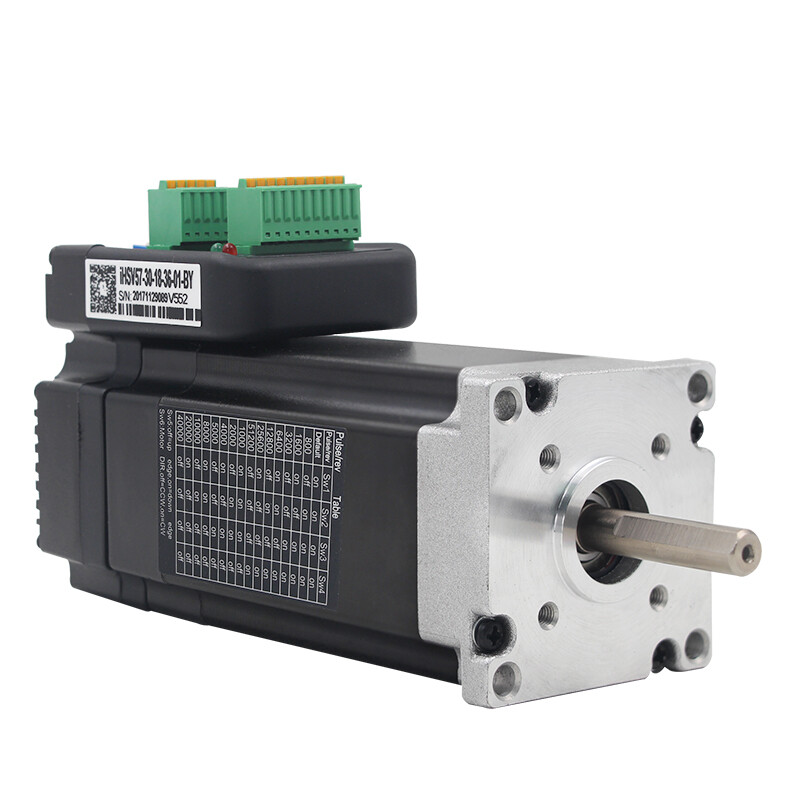
Closed-loop steppers combine a stepper motor, encoder and compatible drive. The drive uses feedback to correct shaft-position error and can alarm if the error exceeds its configured limit. Integrated models such as JMC iHSS include the drive on the motor.
Key facts:
- Still stepper motors, but with real-time feedback correction in the closed-loop drive
- Cost: ~$50–80 per motor (vs $200+ for true servos, ~$15 for dumb steppers)
- If correction cannot keep error within the configured limit, the drive can alarm; wire and configure that alarm to stop the machine
- Best practice: Feed conservatively, never hit the alarm
JMC iHSS57 is a family of integrated closed-loop stepper motors. Select the full model suffix, torque-speed curve, supply and dimensions; the current iHSS57-36-20 catalog entry identifies 2 N.m holding torque.
When Steppers Actually Lose Steps in Real Work
Common causes to investigate include:
- Wrong current setting: match the driver's peak or RMS current convention to the motor specification; too little current can reduce available torque.
- Resonance: vibration depends on motor, driver, supply, load inertia and speed. Convert axis feed to motor RPM using screw lead or pulley travel, then test the relevant speed range and tune acceleration and driver settings.
- Cutting load and vibration: check tool condition, engagement, workholding and available axis torque when cutting causes position errors.
- Mechanical drag: check alignment, lubrication, support bearings and nut preload. A ballscrew preload system is different from an adjustable anti-backlash leadscrew nut; use its maker's procedure.
The Resonance Problem (Bigger Than People Admit)
Resonance can cause loss of synchronism even at modest loads. Its importance depends on the motor, driver, transmission and inertia; cutting marks alone do not distinguish it from other vibration sources.
Use a driver with suitable resonance control, appropriate microstepping and a correctly selected coupling. Check the axis mechanics before changing preload or adding compliant couplings, which can also reduce positioning stiffness.
In classic Grbl, $120, $121 and $122 set X, Y and Z acceleration. $31 is minimum spindle RPM. Tune maximum rate and acceleration by testing the axis under load; no universal jog speed avoids resonance.
Budget Comparison Table
| System | Cost/Axis | Feedback | Alarm | Best For |
|---|---|---|---|---|
| Open NEMA23 stepper | $20 | None | No inherent lost-position alarm | Cost-sensitive axes with adequate torque margin |
| Closed-loop NEMA23 (JMC iHSS57) | $70 | Encoder | Drive alarms on configured fault conditions; requires machine interlock | Feedback correction and fault reporting |
| True AC servo (budget) | $300+ | Encoder + drive | Servo drive alarms | Axes needing the servo's speed, torque or control performance |
| True servo (quality, Yaskawa) | $800+ | High-resolution encoder | Drive fault reporting; network features depend on the interface | Professional work |
Which System Actually Runs Unattended?
Open-loop motors do not monitor the cutting process. Supervise a hobby-router job according to its machine instructions; correct motion control does not detect every tool, workholding, dust or fire problem.
Closed-loop stepper alarms are useful only when the controller is configured to react. Test the stop response, including the other axes and spindle, before relying on the fault signal.
Servo systems can support demanding production motion. Unattended machining depends on the complete machine, process monitoring and fault handling, not the motor label.
The Real Honest Verdict
Open-loop steppers can produce accurate parts when the mechanics, driver, current, speed and acceleration are suited to the job. Measure your completed machine instead of assuming a tolerance or a guarantee against lost steps.
Budget each motor, its driver, the transmission, wiring and a share of a correctly sized power supply.
Choose closed-loop steppers when feedback correction and fault reporting solve a real requirement. They still need torque margin, compatible control signals and tested fault handling; integrated and separate-drive packages have different costs.
For JMC iHSS integrated motors, the drive is already included; add power, wiring and control-interface costs rather than another stepper driver.
True AC servos are the third choice, rarely needed. Only pick this path if:
- Your axis needs a wider speed-torque operating range or tighter dynamic following performance
- Your required feeds and accelerations exceed a suitably sized stepper system's performance
- You have the electrical knowledge to set up servo drive parameters
- You're comfortable spending $600+ on the drivetrain
For many hobby routers, properly sized steppers are sufficient. Closed-loop steppers add feedback correction and fault reporting; servos can offer stronger high-speed and dynamic performance. Choose using loads, speed, acceleration and measured machine requirements, not an assumed percentage of home shops or a claimed precision benchmark.
The JMC iHSS57 Middle Ground
JMC iHSS57 motors combine an encoder, drive and a 57 mm-frame stepper. Check the complete model, shaft, mass and dimensions before considering a retrofit; MPCNC Primo uses NEMA 17 mounts, so this is not a stock drop-in motor.
Follow the exact motor manual for supply voltage, step/direction levels, configuration and alarm wiring. Verify direction, motion settings and controller stop behavior during commissioning.
What We'd Buy
For an open-loop build, use a suitable driver such as DM542T for each independently driven motor. Size motors by required torque at speed; gantry machines may need two Y motors and more than three drivers.
For integrated closed-loop motors such as JMC iHSS57, do not add a conventional external stepper driver. Select the motor by the axis load, connect compatible control signals and integrate its fault output.
Choose a servo when its torque-speed curve and dynamic performance justify the cost and setup work for your axis. Experience and support matter, but there is no fixed waiting period.
Parts for this guide
If you are buying after reading this, these are the specs to look for.
| Part | What to buy | Where to look |
|---|---|---|
| Open-loop stepper driver A reader keeping open-loop steppers needs a driver that can supply the selected motors correctly. | StepperOnline DM542T V4.0: 18 to 50 V DC, up to 4.5 A peak or 3.2 A RMS; one per independently controlled motor, matched to motor phase current and controller signal levels. | |
| Integrated closed-loop stepper A reader adding encoder feedback needs a complete compatible motor and drive arrangement for the chosen axis. | JMC iHSS57-36-20 pulse-input version, 57 mm frame, catalog 2 N.m holding torque with integrated drive; verify the delivered revision's voltage range, shaft, dimensions and alarm interface. |
"Search" buttons open a search for that exact spec, so compare listings against it before buying. Some links earn us a commission at no extra cost to you (disclosure).