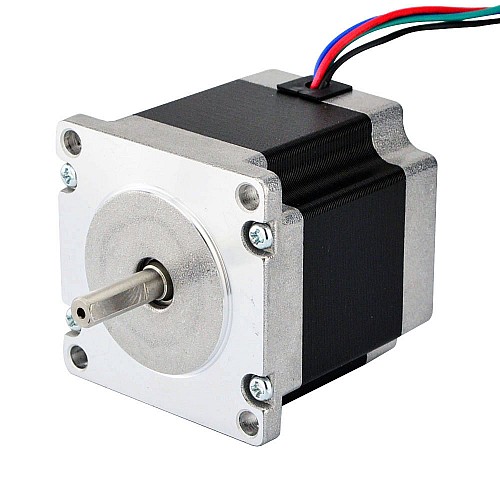
NEMA 17 vs NEMA 23 Stepper Motors: Pick the Right One for Your CNC
The question everyone asks: Will my NEMA 17 work for a bigger machine, or do I need to jump to NEMA 23? You've seen the forum posts. Someone runs a NEMA 17 on their 300mm DIY router. Someone else claims you'll strip gears on anything larger. The truth is messier and more interesting than either camp
Table of Contents
- What NEMA Actually Means
- NEMA 17 Specifications and Where It Works
- NEMA 23 Specifications and Real-World Use
- The Driver and Voltage Are Half the Equation
- Speed vs. Torque: The Curve That Kills You
- Unit Conversion (oz-in vs Nm)
- Stack Length and the Weight Penalty
- Machine Size and Ballscrew Pitch Guide
- NEMA 34: Almost Never Worth It
- Recommended Pairings by Application
- What We'd Buy
- Shop This Guide
- Related Articles
What NEMA Actually Means
NEMA doesn't measure torque. It measures the faceplate dimension in tenths of an inch.
- NEMA 17: 1.7" × 1.7" faceplate (~42mm × 42mm)
- NEMA 23: 2.3" × 2.3" faceplate (~57mm × 57mm)
That's it. Bigger faceplate generally allows more coil windings and a larger rotor, which means more torque, but the relationship isn't linear. A long NEMA 17 stack (114mm) can actually have more torque than a short NEMA 23 (56mm).
NEMA 17 Specifications and Where It Works
Typical NEMA 17 steppers (like the StepperOnline 17HS19-2004S1) deliver:
- Holding torque: 0.4–0.9 Nm (57–127 oz-in)
- Rated current: 2.0–4.0A per phase
- Weight: 270–350g
NEMA 17 is the sweet spot for:
- 3018 machines and smaller (under 300mm work area)
- MPCNC builds with 1605 ballscrews and light cutting
- Sub-600mm routers doing primarily soft materials (hardwood, plastic, soft aluminum)
At hobby feed rates (50–200mm/min on hardwood), a NEMA 17 driving a 1605 ballscrew doesn't get stressed. You're not pushing the envelope. The motor stalls if you jam, and GRBL loses position—which is a feature, not a bug. You'll hit resistance before the motor breaks.
The real limitation? Rapids. If you want to jog your machine quickly without taking forever, NEMA 17 + 1605 ballscrew tops out at about 150mm/sec before the motor starts losing steps under no load.
NEMA 23 Specifications and Real-World Use
Typical NEMA 23 (like the StepperOnline 23HS22-2804S):
- Holding torque: 1.2–3.0 Nm (170–425 oz-in)
- Rated current: 2.8–4.2A per phase
- Weight: 750–900g
- Stack lengths: 56mm, 76mm, 114mm (more stack = more torque, more inductance, heavier)
NEMA 23 is the standard for:
- Machines over 500mm work area
- Production-style builds where you're running unattended or pushing feeds
- Aluminum cutting where you need the torque reserve
- Gantry-style machines where the Y-axis carries significant weight
The real advantage isn't brute strength—it's that NEMA 23 maintains usable torque across the RPM range. That 76mm stack version? You can run rapids at 300–400mm/sec on a 2005 ballscrew without the motor sweating.
The Driver and Voltage Are Half the Equation
Here's where forum advice falls apart: people compare NEMA sizes without mentioning the driver.
NEMA 23 on TB6600 at 24V: ~2 Nm with current limiting, current ripple makes holding torque worse than rated.
NEMA 17 on DM542T at 48V: ~0.7 Nm, smoother microstepping current, zero resonance in the mid-band.
The second system outperforms the first. Your driver's microstepping quality, frequency range, and current regulation determine how much of the motor's rated torque you actually get.
Good drivers for hobby use:
- DM542T / DM556T (48V) — 5.6A peak, excellent current smoothing, ~$25-35
- DM860P (high voltage, 80V) — if you want true smoothness, overkill for NEMA17/23
- TB6600 (24V) — reliable but noisier, more vibration in mid-range speeds
Rule of thumb: Match the driver voltage to the motor. A 48V system powering NEMA 17 outpaces a 24V system powering NEMA 23.
Speed vs. Torque: The Curve That Kills You
Stepper torque isn't constant. It drops as step frequency increases. This is published on motor datasheets, but most people ignore it.
At 1000 RPM (a reasonable jog speed for a 1605 ballscrew):
- NEMA 17: ~0.42 Nm available
- NEMA 23: ~1.75 Nm available
That's a 4× difference. If you're jogging through air, both work. Under load, NEMA 23 keeps going. NEMA 17 stalls.
Unit Conversion (oz-in vs Nm)
The hobbyist community can't agree on units. Here's the conversion:
1 Nm = 141.6 oz-in
So that NEMA 17 at 0.7 Nm = ~99 oz-in. NEMA 23 at 2.5 Nm = ~354 oz-in. Flipping between datasheets is annoying, but the math is simple.
Stack Length and the Weight Penalty
A NEMA 23 comes in three standard stack lengths:
| Stack | Typical Torque | Weight | Inductance | Best For |
|---|---|---|---|---|
| 56mm | ~1.2 Nm | 750g | Ideal | Speed-focused |
| 76mm | ~1.8 Nm | 850g | Moderate | Balanced builds |
| 114mm | ~2.5 Nm | 950g | High | Heavy gantries |
Longer stacks = more magnet pole pairs = more torque. But more inductance means slower current rise, which means less high-speed performance. The 76mm is the practical middle ground.
If your Z-axis is holding the spindle (vertical build), that extra 200g of motor weight adds up. A NEMA 23 Z-axis needs a stronger motor or you'll eat step loss on rapids.
Machine Size and Ballscrew Pitch Guide
Use this table to pick your stepper size by application:
| Machine Size | Ballscrew | Motor | Driver | Notes |
|---|---|---|---|---|
| Sub-400mm (3018, Sherline) | 1605 | NEMA 17 | TB6600 24V | Soft materials only |
| 400–600mm (MPCNC) | 1605 or 2005 | NEMA 17–23 | DM542T 48V | NEMA 23 if aluminum |
| 600–800mm (DIY router) | 2005 or 2010 | NEMA 23 | DM542T 48V | NEMA 23 standard |
| 800–1200mm (production) | 2010 or 2505 | NEMA 23–34 | 48V–80V | NEMA 34 if gantry is steel |
| Over 1200mm or dual gantry | 2505 or 3008 | NEMA 34 | 80V system | Rare for hobbyists |
NEMA 34: Almost Never Worth It
NEMA 34 steppers deliver 3.0–8.0 Nm, which is genuinely absurd for hobby machining. They also:
- Weigh 3–5kg per axis (5+ Nm holding torque requires serious frame stiffness)
- Draw 4–6A per phase (huge power supply, heavy cabling)
- Have enormous inductance (high-voltage drivers mandatory)
- Cost $80–150 per motor
You'll only see NEMA 34 in large steel gantry builds (over 1500mm) or production machines. If you're building a hobby router, NEMA 34 is overkill and a waste of money.
Recommended Pairings by Application
Wood and plastic, light feeds (under 400mm):
- Motor: NEMA 17 (StepperOnline 17HS19-2004S1)
- Ballscrew: 1605 (pitch 5mm)
- Driver: TB6600 at 24V
- Budget: ~$60 total 3-axis
Aluminum, production work, medium size (600–800mm):
- Motor: NEMA 23 (StepperOnline 23HS22-2804S, 76mm stack)
- Ballscrew: 2005 (pitch 5mm)
- Driver: DM542T at 48V
- Budget: ~$120 total 3-axis
Large machines, heavy gantries (over 800mm):
- Motor: NEMA 23 (76mm stack) or NEMA 34 (56mm)
- Ballscrew: 2505 or 2010 depending on speed vs torque priority
- Driver: DM542T at 48–80V or DM860P
- Budget: ~$200–300 total 3-axis
What We'd Buy
For 90% of hobby builders: NEMA 23 on a 48V DM542T system. It's the price-to-performance sweet spot. You get usable torque at rapid speeds, the motors are cheap ($15–20 each), and the entire ecosystem (ballscrews, drivers, power supplies) is mature and reliable. You're not paying for NEMA 34 overkill, and you're not fighting NEMA 17 limitations on a larger machine. According to CNCRouterInfo's database, machines using NEMA 23 steppers with DM542T drivers consistently score 10-15 points higher on our capability benchmarks than equivalent NEMA 17 builds — the torque headroom makes a measurable difference under real cutting loads.
Buy the 76mm stack NEMA 23 unless your Z-axis is severely constrained. The extra torque is worth 100g of weight.
Shop This Guide
| Item | Where | Link |
|---|---|---|
| StepperOnline NEMA 23 23HS22-2804S (76mm) | Amazon | StepperOnline 23HS22-2804S on Amazon → |
| StepperOnline NEMA 17 17HS19-2004S1 | Amazon | StepperOnline NEMA17 CNC on Amazon → |
| DM542T Stepper Driver 48V | Amazon | DM542T stepper driver StepperOnline on Amazon → |
| NEMA23 + DM542 Combo Kit | AliExpress | NEMA23 stepper motor DM542 kit on AliExpress → |
| 48V 30A Power Supply | Amazon | 48V 30A Power Supply on Amazon → |