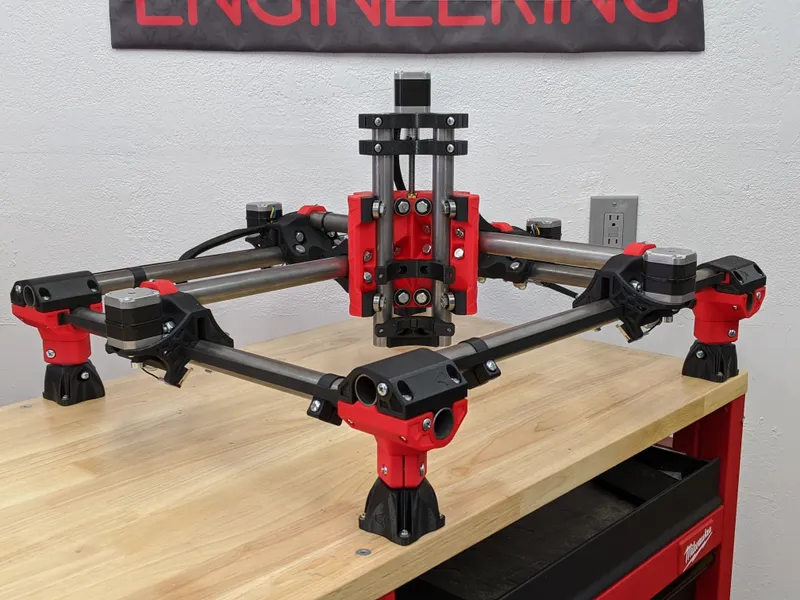
MPCNC Primo: The Mostly Printed CNC Router That Started a Movement
The MPCNC makes hobby CNC accessible by combining printed parts with steel tubes and commonly available hardware. Building it takes printing, assembly, wiring and careful setup, so plan the complete project before buying parts.
Table of Contents
Published in: Open-Source Builds | ~14 min read
The MPCNC makes hobby CNC accessible by combining printed parts with steel tubes and commonly available hardware. Ryan Zellars developed the design through V1 Engineering, which publishes the build instructions and supplies kits. Budget for printing, assembly, wiring and setup as well as the machine parts.
The Primo is the current generation of that machine. It's not perfect. It's not the most rigid thing you can build. But it might be the best documented, most community-supported, and most cost-effective entry into serious hobby CNC routing that exists. Let's dig into what it actually is.
What Is the MPCNC Primo?
The MPCNC uses printed corners, trucks, core and tool mounts with steel tubes as rails. Choose one of the supported outside diameters and measure local stock before printing. US 3/4 in EMT fits the 23.5 mm version; conduit naming and sizes differ by country.
The printed assemblies and bearings ride on the tube rails. You can choose the work area, but longer spans reduce rigidity. Keep the machine only as large as the work requires and use V1's sizing guidance.
V1 Engineering sells kits and printed parts for builders without a printer. Free STL downloads are linked from the official documentation; use the correct Primo tube-size version and observe the design-file license.
The Primo vs. Its Predecessors
Burly was an earlier MPCNC revision, not the original version. Primo changes the printed assemblies and uses wider belts in the recommended build, while retaining choices of tube diameter:
- More rigid core assembly with better gantry stiffness
- Simplified rail geometry (fewer parts)
- Better tool mount compatibility
- Improved Z-axis design
- Cleaner cable routing
A Burly build guide covers an older revision. Use the Primo documentation for Primo parts and check every hardware substitution. The designs are freely downloadable under V1's stated noncommercial license, which is distinct from unrestricted open-source hardware.
Key Specs and Build Options
Rail diameter: C uses 23.5 mm OD, F uses 25 mm OD, and J uses 25.4 mm OD. US 3/4 in EMT fits C. Measure your actual tubes and print the matching version; close enough is not a fit specification.
Work area: choose the smallest size that suits your projects. The 3 m belt quantity in V1's example covers roughly 780 mm of combined X and Y workspace; that is a belt allowance, not a rigidity limit. Use the calculator for larger builds.
Z size: V1 recommends the shortest Primo build setting of 81 mm for rigidity. Check the calculator and your tool reach; usable stock clearance is not the same as unrestricted cutting depth.
Recommended tool: V1 provides Primo mounts for the Makita RT0701C and DeWalt DW660, plus spindle alternatives. Check the exact mount file before buying; a DWP611 needs a mount intended for that router.
Motors: five NEMA17s in the standard build, two on X, two on Y and one on Z.
Controller: V1 recommends Jackpot with FluidNC. SKR Pro with Marlin remains documented; choose the board and matching firmware configuration together, including independent drivers if using dual-endstop squaring.
What Does It Actually Cost?
This varies significantly by country and how much you source vs. buy from V1 Engineering, but a realistic US build in 2025:
| Component | Source | Estimated Cost |
|---|---|---|
| Printed parts | Print the official PLA parts or buy the correct tube-size set from V1 | $15–60 |
| Steel tubes in the measured OD matching C, F or J parts | Local hardware store | $25–40 |
| Hardware and motion components, with rail tubing sourced separately | V1 Engineering shop | $55–75 |
| Five NEMA17 motors plus compatible drivers | Amazon / V1 | $60–80 |
| Controller board (SKR Pro or Jackpot) | V1 Engineering | $50–90 |
| Power supply matched to the controller; V1's kit lists 24 V, 40 W or more | Amazon | $25–35 |
| Makita RT0701C (router) | Amazon | $90–115 |
| Wiring, connectors, misc | Amazon / local | $20–30 |
| MDF spoilboard | Local | $10–20 |
| Total | ~$350–500 |
Separate the cost of printing your own parts from buying a finished set. V1 estimates about 2.2 kg of PLA for Primo, so calculate filament cost from your actual spool price. Keep the electronics bundle, router, tubing and table costs distinct.
What Can It Actually Cut?
Let's be direct about this.
Excellent at:
- MDF, plywood, soft woods (pine, poplar)
- Foam (EPS, XPS, HDU sign foam)
- HDPE, acrylic, thin PVC
- PCB milling (with care)
- 3D carving in wood with appropriate feeds and speeds
Possible with care and proper settings:
- Hardwoods (oak, maple, walnut) — light DOC, sharp bits, patience
- Aluminum with suitable tooling, light engagement and a compact, well-tuned build
- Carbon fiber (requires dust management, proper bits)
Not really designed for:
- Aluminum milling with any kind of depth
- Parts whose tolerances exceed the measured capability of your completed machine
- Production requiring guaranteed throughput and repeatability without individual machine validation
The rigidity limitation is the conduit. For any serious aluminum work, look at PrintNC instead.
Strengths That Don't Show Up in Spec Sheets
The documentation is genuinely exceptional. V1 Engineering maintains thorough build guides, wiring diagrams, and CAM tutorials. For a first CNC build, this matters enormously — a machine with slightly worse specs but excellent docs will teach you more in the first three months than a better machine with no community.
The community is huge and helpful. The V1 Engineering forums have answered every question you're going to have, probably multiple times. Search before posting and you'll almost always find a thread.
It's infinitely repairable. Broke a printed part? Print another. Want to change the size? Recut conduit and reprint the relevant pieces. This is a machine you can maintain with $5 of filament and a weekend.
You can make it what you need. Dual endstops for auto-squaring, custom tool mounts, laser diode adapters, plasma cutter setups — the community has done all of it and documented it.
Weaknesses Worth Knowing About
Conduit rigidity has a ceiling. Once your machine is big enough that aluminum cutting becomes important, you'll hit a wall that no amount of tuning fixes. This isn't a bug — it's a design choice that prioritizes cost and accessibility over raw rigidity.
Plan Z size, stock thickness and cutter reach together. Keep Z short for rigidity, and do not exceed the cutter's usable reach or allow its shank or holder to rub the stock.
Setup and tramming takes time. The flexible nature of the build means you'll spend a few hours getting everything square and parallel before your first good cut. Follow the docs religiously — it's not complicated, just thorough.
Marlin for CNC is... fine. It works, the community uses it, but coming from a pure CNC background it feels like a 3D printer firmware wearing CNC clothes. The Jackpot/FluidNC option is cleaner from a CNC perspective.
Getting the Parts
Printed parts: V1 recommends PLA for accuracy and rigidity. PETG is acceptable if dimensions are verified and you accept reduced rigidity. Use the specified per-part settings, or buy from V1 or an authorized seller.
Hardware kit: check the selected V1 bundle's contents for fasteners, bearings, belts, drive parts and electronics. Rail tubes, the table, router and any unselected printed parts must be budgeted separately.
Electronics: choose a documented V1 controller bundle and the matching Primo configuration. Jackpot uses FluidNC; SKR Pro uses Marlin. Check whether drivers, power supply and display are included in the option you order.
Conduit: Buy locally (Home Depot, Lowes, local electrical supplier). Don't order it shipped — it's 10-foot lengths of metal tube and shipping costs are silly.
Trim router: The Makita RT0701C is the community standard for good reasons: variable speed, 1-1/4 HP, compact form factor, widely available, inexpensive to repair.
Shop: Makita RT0701C on Amazon →
Shop: V1 Engineering Hardware Kit (Official) → (non-affiliate — direct to community)
Shop: NEMA17 Motor Kit on Amazon →
Shop: Controller-Compatible Power Supply on Amazon
Who Should Build an MPCNC Primo?
Build one if:
- You want your first real CNC router and can already 3D print
- You're primarily cutting wood, foam, and plastics
- You value community support and documentation over maximum performance
- Budget is real — sub-$500 is difficult to beat for what you get
- You like building things and want to understand what you're running
Don't build one if:
- Your primary goal is cutting aluminum reliably (look at PrintNC instead)
- You have zero interest in the build and just want to cut things (look at kit machines)
- You need sub-0.05mm positional accuracy out of the box
- You want something portable or rigid enough to travel with
The MPCNC Primo is where a lot of serious CNC hobbyists started. It teaches you feeds and speeds, CAM, fixturing, and machine care in a context where mistakes are cheap. That's worth something that doesn't show up in any spec sheet.
Further Reading
Quick Reference
| Spec | Value |
|---|---|
| Rail diameter | 23.5, 25 or 25.4 mm OD, matching C, F or J parts |
| Max practical work area | Build-dependent; smaller spans improve rigidity |
| Z travel | 81 mm recommended minimum Z build setting |
| Recommended spindle | Makita RT0701C |
| Motors | NEMA17, five total |
| Controller | Jackpot recommended; SKR Pro is a documented alternative |
| Firmware | Marlin or FluidNC |
| Typical build cost | $350–500 |
| Best for | Wood, foam, plastics, PCB milling |
| Community | forum.v1e.com |
All affiliate links on this page support the site at no extra cost to you. We link to official V1 Engineering resources without affiliate tracking because the project deserves it.
Parts for this guide
If you are buying after reading this, these are the specs to look for.
| Part | What to buy | Where to look |
|---|---|---|
| PLA filament for Primo parts The builder needs dimensionally accurate structural prints before assembling the tube frame. | PLA matching the printer's filament diameter; allow about 2.2 kg for the official parts plus allowance for test pieces, and use V1's per-part infill settings. | |
| Primo NEMA17 motor set The builder needs two motors on X, two on Y and one on Z for a complete build. | Five NEMA17 motors, at least 50 oz-in holding torque as listed by V1, with 5 mm shafts and phase current compatible with the chosen drivers. | |
| Primo belt and pulley set The builder needs matched belt width and pulley geometry to drive both sides of X and Y. | GT2 fiberglass-reinforced belt, 2 mm pitch and 10 mm width; four 16-tooth pulleys for 10 mm belt with 5 mm bores; calculate belt lengths for the chosen work area. | |
| Primo sealed bearings The trucks and core require the full bearing set to ride on the tube rails. | 45 type 608-2RS sealed ball bearings, as linked from the official Primo BOM. |
"Search" buttons open a search for that exact spec, so compare listings against it before buying. Some links earn us a commission at no extra cost to you (disclosure).