CNC Workholding Methods: From Tape to Vacuum
Workholding failure is the #1 cause of tool breakage on hobby CNC machines. A part that shifts by 1mm mid-cut hits the machine bed or support structure. Your $30 end mill snaps. You spend 20 minutes cleaning up debris. Then you realize you weren't holding the work down at all—you were just hoping.
Table of Contents
- The Workholding Hierarchy: Bad Ideas (Costing You Tools)
- Double-Sided Tape: Surprisingly Effective
- Step Clamps with T-Track: The Universal Standard
- Toe Clamps: Lower Profile, Faster Release
- Threaded Wasteboard Inserts: Build It Once, Clamp It Forever
- Tape + CA Glue Method: Hybridized and Brutal
- Vises: For Metal and Precision Work
- Vacuum Table: The Gold Standard
- The Principle: Workholding Failure Costs More Than Prevention
- Quick Selection Matrix
- Real-World Advice from the Community
- Verdict: Tape for Quick Work, Clamps for Everything Else
- Shop This Guide
- Related Guides
The Workholding Hierarchy: Bad Ideas (Costing You Tools)
Workholding failure is the #1 cause of tool breakage on hobby CNC machines. A part that shifts by 1mm mid-cut hits the machine bed or support structure. Your $30 end mill snaps. You spend 20 minutes cleaning up debris. Then you realize you weren't holding the work down at all—you were just hoping.
Here's the honest progression:
- Gravity alone (worst idea)
- Clamping with C-clamps (hope-based engineering)
- Double-sided tape (works, but has limitations)
- T-track clamps (professional standard for routers)
- Threaded wasteboard inserts (best for repeat setups)
- Vacuum table (the gold standard, difficult DIY)
I've broken tools at every level. The difference between methods #3 and #4 is the difference between "okay, that worked" and "I trust this machine." Let's talk about each.
Double-Sided Tape: Surprisingly Effective
The tape: Shurtape (carpet tape, construction tape) is the community standard. It's not duct tape. It's not painter's tape. It's specifically designed for bonding carpet to concrete, and it's incredibly strong.
How it works: A thin layer of natural rubber adhesive on both sides. You tape the wasteboard, stick your work to the tape, and it doesn't move. Pull the work off, clean the residue, and repeat.
Why it works so well:
- Contact area = strength. A 100×200mm workpiece with full tape coverage grips hard.
- The tape flexes slightly, damping vibration (this is actually good)
- Cost: ~$0.50 per job
- Reversible (no permanent damage to the work)
Gotchas:
- Humidity and dust kill adhesion. A dusty or wet work surface loses grip. Clean both surfaces (work and wasteboard) with a dry cloth or compressed air immediately before taping. This is non-negotiable.
- Thin/light stock is risky. Taping a 1/8" plywood sheet has less glue-to-surface area. If your toolpath has aggressive spiral climbs or heavy feeds, it might slip. Tape two sides if you're worried.
- Removal is messy. Use a plastic scraper (not a metal one, which damages the wasteboard) to lift the edge, then gradually peel. Residual adhesive comes off with goo-gone or isopropyl alcohol.
- Oily woods (like teak) don't tape well. Sand the surface first.
Real-world success rate: 95% of V1 community builds that use tape report zero issues. The 5% didn't clean the surface properly.
Cost: $15 for a roll of Shurtape; you'll cut 20+ jobs from one roll.
Step Clamps with T-Track: The Universal Standard
The setup: Your wasteboard has T-track channels routed or bolted to it. Step clamps hook over the T-track and press down on the work.
Why it's the hobby standard:
- Clamps can be positioned anywhere (infinite flexibility)
- Low-profile (clamps stay clear of the bit in most cuts)
- Extremely strong (torque the clamp bolt and nothing moves)
- Reusable indefinitely
- If a clamp gets in the way, unscrew it and move it
Gotcha: A clamp can be in the path of your tool if your design isn't careful. Plan toolpaths to avoid clamps, or use low-profile clamps that sit closer to the surface.
Setup: Route 1/4" or 5/16" wide T-track channels into your 3/4" MDF wasteboard. Space them 100–200mm apart. Clamps bolt into the channels using T-nuts.
Alternative: Bolt T-track to the surface instead of routing. Takes 20 minutes, your wasteboard stays flat, and you can adjust the track later.
Community standard: Most CNC Zone builds that use extrusion use T-track. It's proven, modular, and fast.
Cost: T-track kit (aluminum rails + T-nuts + clamps): $80–150 for a 600×600mm wasteboard. One-time investment.
Toe Clamps: Lower Profile, Faster Release
What they are: A clamping block mounted on a pivot pin, with a screw-down lever. When you turn the screw, the block slides under the work and clamps. When you back off, it releases.
Advantage over step clamps: Foot-print is smaller, and release is one turn of a screw vs. multiple unbolts.
Disadvantage: They're fiddly to mount and adjust. Less common in the hobby community.
Cost: $30–60 per clamp.
When to use: High-volume repeat setups where you're clamping/unclamping the same size part dozens of times.
Threaded Wasteboard Inserts: Build It Once, Clamp It Forever
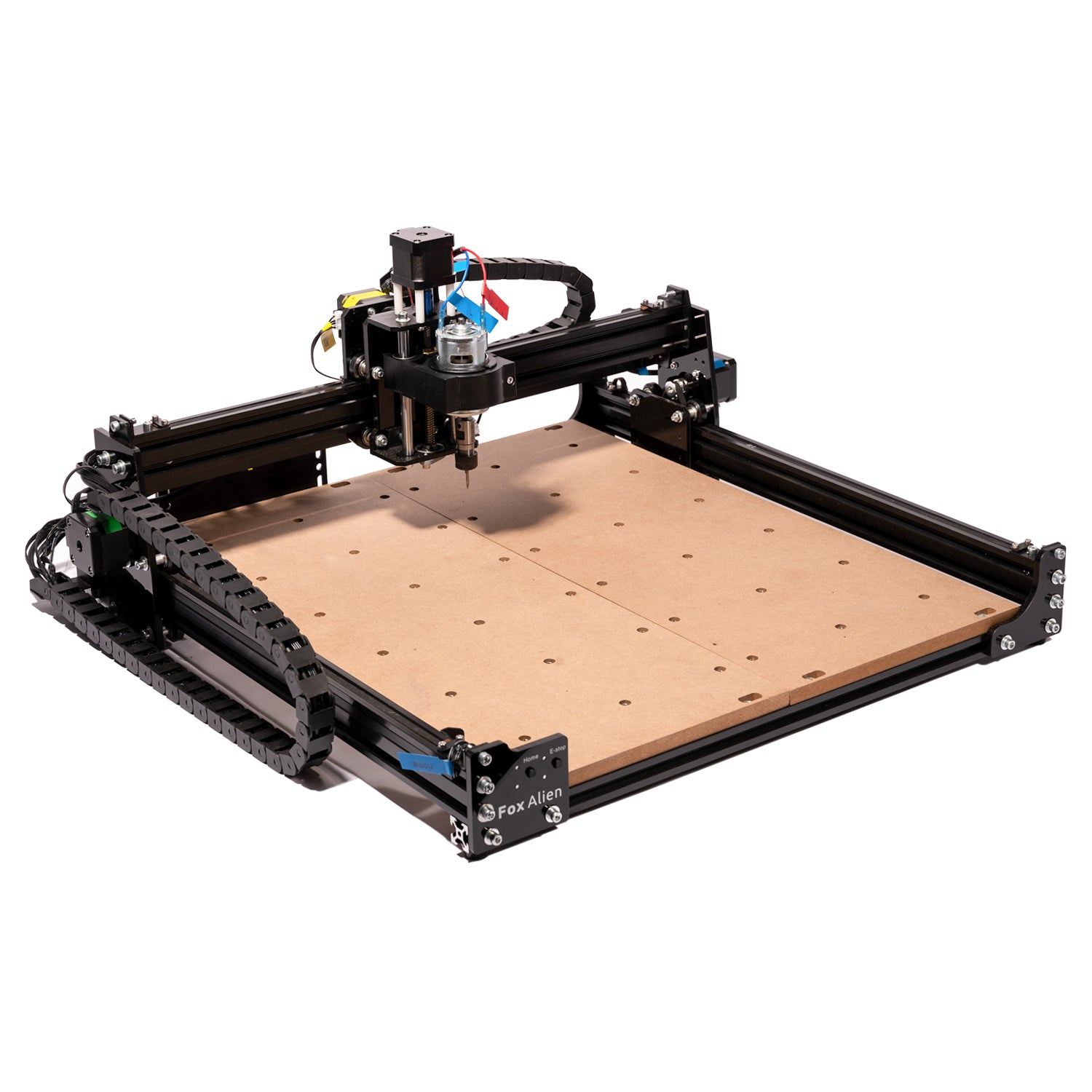
The method: Drill a 5×5mm or 10×10mm grid of holes in your 3/4" MDF wasteboard. Press-fit threaded inserts (M5 or M6) into the holes. Now you can bolt work directly to the wasteboard using any configuration of bolts.
Why this is powerful:
- Zero clamping hardware in the way (bolt heads sit flush or slightly proud)
- Infinite positioning (any hole, any direction)
- You can bolt aluminum stock directly—no tape, no clamps
- Setup is a one-time project; repetition jobs are trivial
How to set it up:
- Design a hole pattern (5mm spacing = dense coverage, 10mm = coarser)
- Make a drill template from hardboard
- Drill your holes (20 minutes for a 600×600mm board)
- Press-fit the inserts (hand-tighten or use a tool)
- Bolt your work using washers and M5 bolts
Gotcha: Tapping holes exposes the wasteboard edge grain, which can swell with humidity. Some builders seal the holes with CA glue or lacquer.
Community tip: CNC Zone builders who use this method almost always recommend it in retrospect. "Why didn't I do this earlier?" is the common refrain.
Cost: Threaded insert kit (100 pieces): $10–20. Drill template: $0 (DIY hardboard).
Tape + CA Glue Method: Hybridized and Brutal
The technique: Apply Shurtape to both the wasteboard and the back of your work. Press the work onto the tape. Then, apply a small drop of instant adhesive (cyanoacrylate / CA / superglue) along one edge to lock it in place.
Why it works: The tape handles 90% of the holding force; the CA glue is just a lock to prevent any sliding.
Release: Lift the work, pull it off the tape, and the CA joint pops off cleanly (it's weak in shear when the surfaces are separated). Very little residue.
Real-world use: This is overkill for most jobs, but I've used it for aggressive aluminum cuts where I didn't want any movement. Works flawlessly.
Gotcha: CA glue is irritating and dries fast. Don't get it on your fingers, and have acetone nearby for cleanup.
Cost: Negligible (small drop of CA).
Vises: For Metal and Precision Work
When to use: Milling aluminum, cutting steel, any work where you need repeat precision in one orientation.
The catch: A vise must be trammed into your CNC. That means the jaws are perfectly parallel to your Y-axis and perfectly perpendicular to your X-axis. One degree of tilt, and you'll have varying depth issues.
Setup time: 20–30 minutes with a dial indicator.
Advantage: Once trammed, you can clamp the same part 100 times in the exact same position. Repeatable to ±0.1mm.
Vise selection: A 3–4" machine vise ($40–100) is plenty. Avoid hardware store "hobby" vises—the jaws aren't parallel enough.
Gotcha: A vise is bulky and eats workspace. If your machine is small (under 400×400mm), a vise is impractical.
Community use: Aluminum cutters and metal routers use vises. Wood routers rarely do (tape and T-track are faster).
Cost: $50–150 for a decent vise.
Vacuum Table: The Gold Standard
What it is: A flat, porous base (MDF with vacuum holes, or a commercial vacuum plate) connected to a shop vac. Suction holds the work down.
Why it's the ultimate:
- Works on thin sheet stock (plywood, MDF, acrylic) that clamps can't hold
- No clamps in the way; entire surface is clamping area
- Fast (just hit the vacuum switch)
- Repeatable
Why it's hard for DIYers:
- Requires a shop vac and ducting
- DIY versions are finicky (leakage is constant battle)
- MDF vacuum bases eventually wear out (holes enlarge)
- Thin stock can "flutter" if suction isn't strong enough
DIY approach that mostly works:
- Get a 4×8 sheet of melamine (plastic-coated plywood)
- Drill a grid of 3–5mm holes (5mm spacing = adequate coverage)
- Connect a manifold (PVC pipe) under the board to your shop vac
- Route the air from holes through the manifold to the vac
Reality: This works, but sealing is tedious. Air leaks, suction drops, the board warps from moisture (MDF is hygroscopic). After 6 months, you're re-drilling holes.
Commercial alternative: Buy a vacuum table ($500–2000+). They work flawlessly because engineering solved the leakage problem. Overkill for hobby use.
Emerging solution: Non-slip mat under thin stock. A simple rubber matting ($20) under plywood or acrylic provides enough friction to prevent movement in most cases. Not as reliable as vacuum or clamps, but fast and zero setup.
Cost: $100–200 for DIY (worth it if you cut thin sheet stock regularly); $500+ for commercial.
The Principle: Workholding Failure Costs More Than Prevention
A broken $30 end mill costs $30. The time to clean up, diagnose the breakage, and restart costs an hour ($20 of your time, conservatively). A shifted part that ruins a 30-minute job costs 30 minutes. Multiply that across a year of projects, and workholding investments pay for themselves in weeks.
Never underinvest in workholding. It's the easiest place to save money on a CNC machine, and it's the worst place to cheap out.
Quick Selection Matrix
| Work Type | Best Method | Cost | Setup Time |
|---|---|---|---|
| Thin plywood sheet | Vacuum table or non-slip mat | $20–200 | 5 min |
| Solid wood panels (1"+ thick) | Double-sided tape + optional clamps | $1–50 | 5 min |
| Hardwood or soft metals | T-track clamps | $100–150 | 10 min |
| Aluminum (production) | Threaded inserts or vise | $20–100 | 15 min setup, 2 min repeat |
| Small precision parts | Machine vise | $50–100 | 20 min setup, 2 min repeat |
| Repeat batches (same size) | Threaded inserts or fixture jig | $30–100 | 30 min initial, 5 min repeat |
Real-World Advice from the Community
From CNC Zone veterans:
- "T-track clamps are the move if you're building seriously. Don't cheap out."
- "Tape works if you clean the surface. Dirty surface = broken tool."
- "Threaded inserts are the best $30 I spent. I wish I'd done it from day one."
- "Vacuum is nice, but honestly, for wood, tape is faster."
From V1 Engineering forum:
- "We use tape on LowRider. It works great for sheet goods. Add one clamp if you're worried."
- "For repeat jobs, threaded inserts and T-nuts. One-time setups, tape."
Verdict: Tape for Quick Work, Clamps for Everything Else
For a new builder: Start with double-sided tape (Shurtape). It's cheap, effective, and teaches you the limitations. When you break a tool due to tape failure (it happens), upgrade to T-track clamps.
For production or precision: Threaded wasteboard inserts ($20 investment, 20 minutes to install). You'll never regret it. This is the "set it and forget it" solution.
For aluminum or metal: Machine vise, properly trammed. No exceptions.
For thin sheet: Vacuum table if you cut sheets regularly; non-slip mat for occasional work.
The hierarchy exists because different work demands different approaches. Understand which method suits your job, and workholding becomes boring (the goal—you want your failures elsewhere).
Shop This Guide
| Item | Price Estimate | Link |
|---|---|---|
| Shurtape Carpet Tape (1 roll) | $12–18 | Carpet Tape → |
| T-Track Aluminum Kit (24") | $40–70 | T-Track Kit → |
| Low-Profile Step Clamps (set) | $60–100 | Step Clamps → |
| Threaded Insert Kit (M5, 100 count) | $10–15 | Threaded Inserts → |
| Machine Vise (3" jaw) | $45–80 | Precision Vise → |
| CNC Clamp Assortment | $40–80 | Clamp Set → |
| Non-Slip Rubber Mat | $15–25 | Non-Slip Mat → |